Sunday, November 01, 2009

The reason I worry about H1N1...

Not personally.  I'm too old.
So why is it that older people would be more trusting of vaccines?
One reason is that people over the age of 65 remember a time when there were no vaccines. Polio, measles, whooping cough, and mumps were all diseases that caused grave illness before there were vaccinations. The polio and whooping cough vaccines were developed in the 1950s, the measles vaccine in 1968. Older generations remember these illnesses and a time when infectious diseases were not only more prevalent, but more deadly.
Those of us who are younger than 60 do not remember these times. Yet, we may recall that in 1976, there was concern that a similar swine flu vaccine was possibly linked to Guillain-Barre syndrome and that more people contracted this illness than the flu, which never really affected the population as was feared. However, the CDC reports that every year an estimated 3,000 to 6,000 Americans develop Guillain-Barre syndrome, whether or not they've received a vaccination.
Since I am not a physician, I am in no position to recommend or discourage the H1N1 vaccine or the standard flu vaccine. As with all issues related to personal health, vaccinations are an individual choice. And as I've discussed before, there are a myriad of reasons that people choose not to follow Western medical advice. I do think however, it's worth bearing in mind what the older generation may be able to teach us: Many people have died of diseases that are prevented today by vaccines. As is often the case with generational differences, older people have lived a history of which younger people have no experience. And although it is a typical human tendency to forget, or deny the lessons to be learned from the past, when it comes to healthcare, many older people remember a time when modern medicine was not an enemy, but a source of protection that prevented death.  [More]
But the trendy rejection of science and the conflation of folk wisdom with understanding of nature threatens to make this flu more of a problem than it should be with our modern resources.

The anti-vaccination movement has the potential to inflict serious harm on the most likely victims of swine (H1N1) flu.  
But the underlying argument has not changed: Vaccines harm America’s children, and doctors like Paul Offit are paid shills of the drug industry.
To be clear, there is no credible evidence to indicate that any of this is true. None. Twelve epidemiological studies have found no data that links the MMR (measles/mumps/rubella) vaccine to autism; six studies have found no trace of an association between thimerosal (a preservative containing ethylmercury that has largely been removed from vaccines since 20011) and autism, and three other studies have found no indication that thimerosal causes even subtle neurological problems. The so-called epidemic, researchers assert, is the result of improved diagnosis, which has identified as autistic many kids who once might have been labeled mentally retarded or just plain slow. In fact, the growing body of science indicates that the autistic spectrum — which may well turn out to encompass several discrete conditions — may largely be genetic in origin. In April, the journal Nature published two studies that analyzed the genes of almost 10,000 people and identified a common genetic variant present in approximately 65 percent of autistic children.
But that hasn’t stopped as many as one in four Americans from believing vaccines can poison kids, according to a 2008 survey. And outreach by grassroots organizations like Autism One is a big reason why. [More]


This idea - rejecting science that contradicts how we think things should be is familiar to farmers. Consider the EU hormone ban. Or anti-GMO activists.

I find the same cafeteria approach to science in the debate over anthropogenic climate change. And before you fire up your response, consider this emotion is exactly how anti-vaxxers feel.
The rejection of hard-won knowledge is by no means a new phenomenon. In 1905, French mathematician and scientist Henri PoincarĂ© said that the willingness to embrace pseudo-science flourished because people “know how cruel the truth often is, and we wonder whether illusion is not more consoling.” Decades later, the astronomer Carl Sagan reached a similar conclusion: Science loses ground to pseudo-science because the latter seems to offer more comfort. “A great many of these belief systems address real human needs that are not being met by our society,” Sagan wrote of certain Americans’ embrace of reincarnation, channeling, and extraterrestrials. “There are unsatisfied medical needs, spiritual needs, and needs for communion with the rest of the human community.”
Looking back over human history, rationality has been the anomaly. Being rational takes work, education, and a sober determination to avoid making hasty inferences, even when they appear to make perfect sense. Much like infectious diseases themselves — beaten back by decades of effort to vaccinate the populace — the irrational lingers just below the surface, waiting for us to let down our guard. 

This flu is already serious and promises to strike at the very most painful core of our society - our children. America stands for allowing citizens to hold and promote their beliefs, but make no mistake about granting credence to the anti-science crowd, whether it is creationism or anti-vax.  It undermines the very foundation of not just our profession, but our culture.
I was hoping for X-ray vision...

We often forget the process of evolution did not stop when Darwin first outlined how it works.  So while it's really hard to discern, our species is still selecting the best package of genes for survival.

Here are what we might be choosing.
Several traits did indeed appear to be undergoing selection.  From the amount of this selection, we can predict the percentage change in the trait that we expect to see after ten more generation of reproduction (roughly 300 years from now).
Total cholesterol: going down.  Projected to drop 3.6% in ten generations
Weight:  going up a tad, projected to increase 1.4% in ten generations
Height:  we’re getting shorter projecting a drop of 1.3% (2.1 cm) in ten generations.
Systolic blood pressure:  Going down, as predicted. Projected to drop 1.9% in ten generations.
Age at menopause:  Going up; projected to rise 1.6% (0.8 years) in ten generations.
Age at first reproduction: Going down. Projected to drop 1.7% (from 26.18 to 25.74 years).
So women, at least, are getting shorter,  stouter, and reproducing earlier and over a longer period of time.   This is evolutionary change.  Based on this study, we can tentatively say, with more assurance than I used to, that yes, our species is still evolving.
But there are two important caveats to this study, both of which were recognized by the authors.
1.  The “inheritance” of the trait includes not just genetic inheritance, but cultural inheritance.  Humans pass not only their genes to their offspring, but aspects of culture that may mimic a genetic inheritance.  For example, parents who eat a lot may induce their kids to eat a lot, and some of the correlation of weight between parents and their kids may be due not to shared genes, but to shared food.  Parents who for cultural reasons have their kids early may induce their own kids to produce grandchildren early.  As the authors say, “We are not able to differentiate the effects of genes and culture with these data.”
This is a bit of a problem, because the evolutionary projections are based on assuming that all of inheritance is genetic.   It’s hard to get around, since distinguishing genetic from cultural inheritance involves difficult work using data from adopted children or twins raised together versus apart.  Nevertheless, we can probably assume that some selection is acting on these traits, discounted by the degree to which parent/offspring resemblance reflects cultural similarity.
2.  The predictions may be hard to verify, because they assume that the environments of our species — that is, the environments that are relevant to each trait — will remain constant over the next few generations. Cholesterol is predicted to drop from 224 to 216 mg/100 ml blood over the next ten generations, but this assumes that diet is constant.  If people stop eating fatty foods, the drop may be even steeper because of this dietary change.  Conversely, if people flock even more frequently to fast-food joints,  the predicted drop may be negated by an increased intake of burgers and fries.
These problems mean that one has to be a bit careful about not only predicting the degree of selection, but also testing those predictions in the future. Yesterday Stearns was on NPR’s Science Friday, discussing how the authors deal with the conflation of culture/environment and genes, and why the prediction of increasingly plump women may not be what it seems. [More]

Discussions of this nature help me keep in mind how transitory our lives are, and how we invest so much importance on stuff that will have minute impact on human history as a whole.

Saturday, October 31, 2009

Curse my long heels...

I blame my parents.
Track coaches have long claimed that the best sprinters are born, not made. Now, new research on the biomechanics of sprinting suggests that at least part of elite athletes’ impressive speed comes from the natural shape of their foot and ankle bones.
Using ultrasound imaging, researchers compared the feet of 12 top college sprinters with those of 12 mere mortals. Surprisingly, the athletes had particularly short heels and longer-than-average toes — features that actually put them at a mechanical disadvantage when running.
“What we found is that sprinters actually had less mechanical advantage than the non-sprinter subjects that we tested,” said biomechanics researcher Stephen Piazza of Penn State University, co-author of the study published Friday in the Journal of Experimental Biology. “This was surprising to us because we expected that sprinters needed all the help they could get.” [More]

It's a wonder I get anywhere.
What's the deal with Argentina?...

Who loves us?  Or who loves the US?

The table above (from PEW and the APSA report I blogged about earlier) shows that there is considerable variation across both time and space in how favorably publics regard the United States. There is much of interest to be explored here, especially for our political behavior audience given that PEW is very generous in making its data available for further analysis.
There is a notable Obama jump, especially in Europe but also in some other countries like Indonesia, Nigeria, and Brazil. It is not clear whether foreign publics like Americans better because they elected Obama or that they like the U.S. better because it now has a president they believe they can work with. It is also not clear what actual cooperation this will buy Obama. A clever political scientist may figure out a way to study that question.
The patterns do suggest that publics are responsive to policy. The Iraq war led to drops in support, especially in the Muslim world. In Russia, the main drop came with the Kosovo war (this is better visible in time trends that go back further). In Asian countries where the US provides strong public goods, support is pretty high. In countries where the US provided tsunami relief, support for the US went up. (One would almost suggest that interests matter, but that would be heresy in the public opinion world.) [More]

Of course we don't care what the rest of the world thinks, right?  Except China, of course (since they hold a bunch of our debt).  And maybe the UK, since they have supported our wars faithfully.  And Israel, since their lobbyists can beat up anybody else's.  And maybe Russia.  And Saudi Arabia....

Whatever.

Friday, October 30, 2009

Another take...

Heard from the IL Corn Growers today.  This is the (lengthy headline):

CONSERVATION IS KING: DID YOU KNOW THAT CORN FARMERS CUT SOIL EROSION 44 PERCENT IN TWO DECADES BY TILLING THE SOIL LESS? [More]

OK. Not quibbling with that conclusion, but wait - there's more!

Here's the source data.

 So my take-away (you have to say that frequently in any serious communications discussion) is this graph.


Source: IDOA

As you can see from the IL Dept of Ag survey linked above, there are several esoteric categories of "till".  I lump them together as "not-no-till", because what farmers are always pointing to environment-wise is how no-till answers critic's questions.

Remember Blake Hurst's now famous answer to Pollan's Omnivore's Dilemma.
The biggest environmental harm I have done as a farmer is the topsoil (and nutrients) I used to send down the Missouri River to the Gulf of Mexico before we began to practice no-till farming, made possible only by the use of herbicides. The combination of herbicides and genetically modified seed has made my farm more sustainable, not less, and actually reduces the pollution I send down the river.  [More]

It may be that Hurst is a committed no-tiller on all his acres, but here in Illinois that experiment is running out of gas, I think.  Read the numbers, build your own graph.  I think we are being a tad duplicitous wrapping ourselves in no-till righteousness when the trend to me looks otherwise.

Most of us know why.  No-tilling corn after corn doesn't work for most of us. As we move to more corn, we move away from no-till, at least on corn/corn acres.  To be sure, no-till beans are climbing somewhat, but let's face it, the fragile soil is bean stubble - not stalks.

Even at face value only 1 acre in 7 of corn is no-tilled in IL and it hasn't changed much in 10 years. Trotting out no-till as our answer to every environmental and energy criticism is dubious misdirection.


Could higher corn prices via more ethanol mandates essentially kill no-till?

I think it's possible.

[One curious note is the sporadic occurrence of this survey.  Don't ask me - our state government is um, hard to rationally explain.  Also, the survey is tabulated in fields, not acres. Again, no idea. Finally, national figures more recent than 2004 are hard to find, but IL was the leading state by acres then.]


Thursday, October 29, 2009

I'm not a fan...

Of Budweiser beer.  But this guy is.
I tend to regard myself as Crooked Timber’s online myrmidon of a number of rather unpopular views; among other things, as regular readers will have seen, I believe that the incitement to religious hatred legislation was a good idea (perhaps badly executed), that John Searle has it more or less correct on the subject of artificial intelligence, that Jacques Derrida deserves his high reputation and that George Orwell was not even in the top three essayists of the twentieth century[1]. I’m a fan of Welsh nationalism. Oh yes, the Kosovo intervention was a crock too. At some subconscious level I am aware that my ideas about education are both idiotic and unspeakable. But I think that all of these causes are regarded as at least borderline sane by at least one fellow CT contributor. There is only one major issue on which I stand completely alone, reviled by all. And it’s this; Budweiser (by which I mean the real Budweiser, the beer which has been sold under that brand by Anheuser-Busch since 1876) is really quite a good beer. [More]

Daniel lays out his case convincingly (it's a great read), right up until I actually taste the suds.
Don't see this sentence very often...

From our counterparts overseas:
Ganari Takahashi’s first career, making pornographic movies, made him $10 million. He hopes his second, growing fruit and vegetables, will help upend a farming system that costs Japanese taxpayers $45 billion a year.
He’s one of an increasing number of Japanese farmers who say they can make a profit by leaving the world’s most heavily subsidized agricultural industry and selling directly to consumers rather than through the national cooperative.
“Profitable farming is the same as pornography,” Takahashi, 50, said in an interview near the 3.2 hectares (7.9 acres) of farmland near Tokyo he bought in 2006. “You have to create an image and make it cool.” He sells eggplants and peppers online and at his vegetable-themed restaurants.
Farmers like Takahashi are challenging Japan Agricultural Cooperatives Group, the country’s dominant distributor of rice and vegetables, which sets the price of everything from feed to fertilizer for its members. Their initiative may help cut subsidies as Japan’s new government struggles to contain spending, as well as lower prices for consumers and make trade agreements easier, said academic Masayoshi Honma. [More] [My emphasis]
Maybe I don't have the right business model (heh).
Before they disappear...

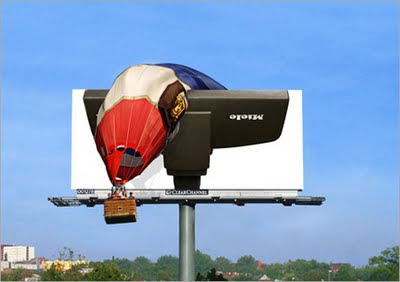
Outdoor advertising, mainly billboards, are suffering in the current business slowdown.
Online, the only platform that is expected to grow this year, will grow 9% this year and reach 14.9% share of global ad expenditure by 2011. Newspaper and magazine ad expenditures will continue to decline through to 2011. Television, cinema and outdoor will return to growth in 2010, followed by radio in 2011. [More]

Like painted barn roofs and sides, we could see the slow decline of this medium.

But before they go, some true masterpieces (these are my 3 favs):


[More]

[via infonation]
Inequality and land values...

I have been following (with difficulty) a series of exchanges about income inequality starting with this by Will Wilkinson.  The arguments have been cogent and enlightening, but I still think the concept of shifting the focus to consumption inequality provides glib non-answers to some very real problems.

Nonetheless, in the midst of this thought, I ran across this view that really struck me as important for farmers and landowners.
So: as income inequality goes up, more money flows to the well-off, who use it to buy financial assets.  Conversely, less money flows to the poor and middle class, who respond by increasing their debt level.  Both of these mechanisms produce a higher demand for financial assets and therefore promote asset inflation.
Turn that around, of course, and you limit asset inflation but promote consumer inflation instead, which has to be held in check via periodic recessions.  So the question is, which would you rather have: periodic modest recessions or long periods of stability interrupted by occasional huge bubbles bursting?  The latter is typical of the "Great Moderation" of the post-1980 era, and Steve argues that it's been economically destructive in multiple ways:
First, in exchange for apparent stability, the central-bank-backstopped "great moderation" has rendered asset prices unreliable as guides to real investment. I think the United States has made terrible aggregate investment decisions over the last 30 years, and will continue to do so as long as a "ride the bubble then hide in banks" strategy pays off. Under the moderation dynamic, resource allocation is managed alternately by compromised capital markets and fiscal stimulators, neither of which make remotely good choices.
Second, by relying on credit rather than wages to fund middle-class consumption, the moderation dynamic causes great harm in the form of stress from unwanted financial risk, loss of freedom to pursue nonremunerative activities, and unnecessary catastrophes for isolated families.
Finally, maintaining the dynamic requires active use of policy instruments to sustain an inequitable distribution of wealth and income in a manner that I view as unjust. In "good times", central bankers actively suppress the median wage (while applauding increases in the mean wages driven by the upper tail). During the reset phase, policymakers bail out creditors. There is nothing "natural" or "efficient" about these choices.
Regular readers will be unsurprised that I generally agree with all this, although I might put it a little more pithily: rich people tend to do really stupid things when they have too much money lying around for too long.  So do poor people, of course, but in their case "too much money" is only enough to buy a bigger TV, not enough to blow up the world.  That's why I think getting a handle on rising income inequality is important.  To paraphrase William F. Buckley, if I had an extra million dollars to divvy up, I'd rather give it to the first thousand names in the New York City phone book than to the CEO of Goldman Sachs. [More]

While I do not currently think farmland is in the bubble category, I do think it will be one wealth-form of choice for those with lots. In the same light, commodities share a common linkage with top-heavy income distribution.

From a Bloomberg survey of economists:
Respondents see China, Brazil and India as the markets with the most potential, and commodities as the asset of choice, replacing stocks as the most desirable investment class in last quarter’s survey. Real estate and bonds are out of favor, with 40 percent saying bonds will have the worst returns over the next year. [More]

To tie it all up, as long as most  of any income gains continue to accrue to a tiny number of people at the top, assets like farmland (which is held separate from "real estate" in most investor eyes) seem to be golden.

Tuesday, October 27, 2009

What if the dollar gets so weak...

McDonald's closes shop?

Hey - it happened in Iceland.
We sort of assumed that McDonald's could be profitable almost anywhere — perhaps even the surface of the moon — but apparently Iceland's economic problems are too much for the world's largest fast food chain to handle.
Bloomberg is reporting that all of Iceland's McDonald's will close at the end of the month due to the collapse of the country's currency. In order to remain open, the restaurants would have had to start charging the equivalent of $6.36 for a Big Mac. According to the Economist's Big Mac Index, the world's most expensive Big Macs are currently located in Switzerland and Norway — where they cost about $5.75. [More]

The puny dollar strikes most farmers as a great thing, since our world trade is essential to profits. I agree, but with some caveats.
  • No whining about oil prices as the buck plumments.
  • There will be some inflation costs on the consumer level, but harder to see on the farm input scene other than...
  • Fertilizer could become very painful again.  In fact, I'd be putting more on right now it I had the umm, cash and it could actually be applied.
Could this ultimately lead to the end of the greenback (are they still truly green?) as the reserve currency?  This is likely already in progress, and I'm not sure there is much we can do about it unless the recession takes a double dip and every other currency look even uglier.
IN SHORT, the dollar-reserve system is already fraying. The question is, what will happen next? Economists are not good at predicting timing—when will all of this happen? And things don’t always move smoothly. During the crisis, the dollar actually strengthened. With the U.S. government providing guarantees on money markets and other deposits—and a U.S. government guarantee having more credibility than that of many developing countries—money sought a safe haven. America, from where the crisis originated, seemed safer than those countries that were the innocent victims.
And the dollar may continue to be strong for some time because what is happening elsewhere could be worse: worries about inflation are also arising in other countries. There may be even less confidence in, say, Europe’s ability to manage its affairs, and if so, the dollar may strengthen further, not because of confidence in the United States, but because of a lack of confidence in other markets. No wonder that, with all these uncertainties, almost the only thing we can be certain of is that markets will be marked with volatility.
As we move (hopefully) toward a global reserve currency, there will be inevitable bumps in the transition along the way. There are, of course, alternatives to the SDRS approach. We may create a multiple-exchange-rate system, in which countries diversify their reserve holdings between the dollar, euro and yen. Over the long run, this system could be highly unstable, as in one period the euro will appear stronger, and funds will shift there, weakening the dollar and strengthening the euro. In another, just the opposite may happen.
Or we may begin to form regional reserve systems. They also manage and dole out reserves for a group of countries but on a smaller scale (along the lines of the Chiang Mai Initiative in Asia, which has been greatly expanded during the crisis). Latin America is discussing doing something similar. One of the ways of creating the global reserve system is through developing and then interlinking these regional efforts.
Whichever path we take, like it or not, we will be moving away from current arrangements, the dollar-reserve system. There are only two questions: will the movement away be orderly or disorderly, and will America play a part in shaping the new system that will emerge? I believe that the transition to the new system will be smoother and that both the United States and the world will benefit if we stop putting our heads in the sand and help create the worldwide reserve system that the globalization of financial markets requires. Keynes recognized the need for such a global reserve currency seventy-five years ago. At the Bretton Woods meeting of 1944, in a costly act of self-interest, the United States blocked the full implementation of Keynes’s scheme. This is an old idea whose time has finally come. [More]

Compared to the 2009 harvest - a work still in progress - the strength of the dollar will remain further down my worry list.


[via free exchange]
Grain Cart Book Review...

For all of you who get stuck in the grain cart, some advice on stuff I've been reading in 12 minute intervals.


Old Man's War by John Scalzi

The premise is targeted right at me:
With his wife dead and buried, and life nearly over at 75, John Perry takes the only logical course of action left him: he joins the army. Now better known as the Colonial Defense Force (CDF), Perry's service-of-choice has extended its reach into interstellar space to pave the way for human colonization of other planets while fending off marauding aliens. The CDF has a trick up its sleeve that makes enlistment especially enticing for seniors: the promise of restoring youth. After bonding with a group of fellow recruits who dub their clique the Old Farts, Perry finds himself in a new body crafted from his original DNA and upgraded for battle, including fast-clotting "smartblood" and a brain-implanted personal computer. All too quickly the Old Farts are separated, and Perry fights for his life on various alien-infested battlegrounds. Scalzi's blending of wry humor and futuristic warfare recalls Joe Haldeman's classic, The Forever War (1974), and strikes the right fan--pleasing chords to probably garner major sf award nominations.
Good writing and several sequels if you like it.  But for a boomer like me the idea of a new, improved version of myself at 75 is pretty darn engaging.  For sci-fi, it's better than most with very strong character development.

Another hint: my Kindle and an LED headlamp work superb in this situation.

What - you were expecting War and Peace?

[Update: No wonder I like his books.]

Saturday, October 24, 2009

Two things...

I've never understood.
  1. Renminbi
  2. Yuan
So: renminbi is the name of China’s currency; but yuan is the denomination of bills, the unit in which prices are measured, etc.. The closest parallel I can think of is Britain’s currency, which is sterling, but whose unit is the pound.
In the case of Britain, however, everyone is easy on talking about the pound’s value, the pound’s exchange rate, and so on; if you talk about sterling’s value, most non-Britons will have no idea what you’re talking about. But for whatever reason, using yuan in the same way draws disapproval.
But here’s the thing: talking about the number of renminbi per dollar is also, as I understand it, wrong — as wrong as talking about the number of sterling per dollar. Renminbi is the currency, but not a unit of the currency. [More]


And...I still don't.

And how do you pronounce it, fer cryin' out loud?

Friday, October 23, 2009

The shirt and shorts...

Don't help.

Is this bike really necessary?


[via infonation]
Color me extremist?...

Since I opine freely (and for free, I should point out) on a wide range of subjects, this may apply:
People with relatively extreme opinions may be more willing to publicly share their views than those with more moderate views, according to a new study.
The key is that the extremists have to believe that more people share their views than actually do, the research found. [More]

But that is where my self-defense kicks in.  I consider my opinions to be almost entirely a minority viewpoint. Let's face it, I oppose ALL ag subsidies, have doubts about ethanol, can understand the objections some have to veal production and gestation crates, and quote from the NYT.

Name one other farmer that far from the mainstream.

But this delusion can create a feedback loop.
“You have a cycle that feeds on itself: the more you hear these extremists expressing their opinions, the more you are going to believe that those extreme beliefs are normal for your community.”
A similar process may occur in groups such as political parties.  Moderately conservative people who belong to the Republican Party, for example, may believe that people with extremely conservative views represent their party, because those are the opinions they hear most often.  However, that may not be true.
Morrison said when she and her colleagues were thinking about doing this study, they had in mind the phrase about the “silent majority” in the United States, which was popularized by President Richard Nixon and his vice-president, Spiro Agnew.  They referred to the silent majority as the people who supported the war in Vietnam, but who were overshadowed by the “vocal minority” against the war.
While there may not be one monolithic silent majority in the United States, Morrison said this study suggests that the minority may indeed be more vocal in some cases.
I'm pretty sure I'm mistaken about a number of my opinions, so I reserve the right to amend them.  That position itself is extreme in an era of "but-you-said-before" journalism.

The interesting thing is how the Internet and blogs have allowed me to inflict these ideas on youse.


What are you thinking?

In fact, blogging may be becoming legit.
In other words, blogging is now a diverse, popular and successful enterprise that covers a multiplicity of online writers, from extensive Twitterers to self-described Mommybloggers to tightly written, up-to-the-minute, smartly edited online publications like this one--a "professional blog" by Technorati standards. And it's in that last sense that blogging is becoming a farm system for future journalists, who are apparently riding out the economic downturn pretty well (on average, at least). Think about that for a moment, and then remember how many traditional journalism jobs have been lost over the same period.
So here's the radical suggestion: Let's redefine what blogging means. If you're writing self-absorbed or inexpert opinions about the minutiae of daily life, without hyperlinks, fact checks or any pretense at engaging with the news, you're a blogger. You probably fall into the lower categories of pay in the Technorati survey if you in fact make any money at all. But if you're a writer for an online publication, one that takes real-time stories, updates them as events unfold, reference your quoted facts, break stories and produce original writing then shall we just say you're a journalist? An online one, but a journalist all the same.
And when you maneuver your thinking in this direction, you come to a strange new conclusion: Journalists who write for online versions of their (perhaps historic, perhaps not) newspapers are the same as journalists who write for totally different online news portals. Even the Pulitzer committee has said online entities can consider themselves eligible for its prestigious prize, with some limitations. [More]

Yeah - a Pulitzer.

There's a goal.

[Thanks, Linda]
As good as it gets...

I have spent the last two days recovering from the "windsprint" bean harvest earlier this week.  We have two days left, weather permitting.  I was simply too pooped to post when I got in. Jan and I never worked much past dark when it was just the two of us and many fewer acres, but this is now and this is 2009: Harvest of Doom.


Ha-ha, just kidding of course.  But then I checked with some friends who were switching back to corn after 2-3 weeks.  Guess how much it had dried in the field?

0.5%  (Which is essentially zero with the rounding error.)

I think the corn may be as dry as it's going to get.

This is not encouraging.  So I'm looking at a 40 year old (my guess) Super B Dryer I have driven around on one farm and estimating how long it will take to push the rest of the crop through my 30 year old Shivvers unit.

I'm taking my time (thanks to the 1.3" rain) looking for options, which is complicated by almost 100% spring 2010 contracts for delivery.  Meanwhile, the grain industry is likewise losing hope of a miraculous solution.

This harvest is about moisture now.
Iowa farmers who were able to get back into fields on October 16 and 17 are reporting that the grain is coming out wetter than normal, with corn moisture content of 30% not unusual. Grain elevators and ethanol plants that buy corn generally want the grain to have a moisture of less than 15%. Farmers will have to spend more money on propane and electricity to dry corn this fall.

Farmers are also reporting corn coming out of the field at kernel weights lower than the 54 pounds per bushel USDA standard that is needed to qualify as the No. 2 Yellow corn grade. In some areas of the state, corn stopped maturing in late September due to the cooler, wetter than normal weather, which has resulted in smaller and lighter weight kernels.

The hard freeze that struck Iowa the weekend of October 10 to 11 put an end to the 2009 growing season pretty much statewide. Farmers say a full assessment of the frost damage to this year's corn crop has yet to be made. There is still some corn with green leaves in some fields in some areas of Iowa.
I'm not the only one airing my frustrations and fears - but I hope I've learned to pause occasionally to try to make some sense. This current situation doesn't look like some speculator conspiracy, just a phenomenally-rare double-fault*.

One question for you ethanol suppliers: Is there an upper limit on moisture you can grind in dry milling plant?

One thing is clear.  This year will be a test for our patience, civility and professional conduct. [Note the even more intense venting on forums (fora?) and blog comment sections] So if I post less than normal, it's because I am less than normal, and I don't want to drift mindlessly over too many lines of propriety in my more anxious moments.

*Please listen to my commentary this week on USFR.

Tuesday, October 20, 2009

Ya know those captions on your TV screen?...

Sometimes they don't work out the way we plan.


[Yet more]

Monday, October 19, 2009

All burgers are not equal...

Some people take hamburgers very seriously.  In fact, it's a little unnerving.


To this end, I decided to do a tasting of "single-malt burgers, carefully noting what distinguishes each cut from the rest, as well as cataloguing all the flavors that come under the umbrella term "beefy," in the hopes of coming up with the ultimate blend. The Blue Label Burger, if you will. I pulled out my boning knife and meat grinder, and headed to the butcher, determined to master the art of burger blending.
In choosing cuts of beef that could go into the burger, I first made a broad decision: This was to be an everyman's burger. Fancy-pants burgers exist, but they are contrary to the spirit of the sandwich. There would be no dry-aged cuts, no special breed cows, and nothing that is more suited for a steakhouse in my blend. Burgers, like good charcuterie, are about taking the cheap and ordinary, and converting it into the sublime. For this reason, I set an upper limit of $8 a pound for the cuts in my mix, which narrowed down my options to eight cuts: sirloin, chuck, short rib, skirt steak, hanger steak, flap meat, brisket, and a surprise entry—oxtail. [More]

Of course, at the other end of the spectrum is the grisly tale of how other burgers are blended that has been much in the news.
The frozen hamburgers that the Smiths ate, which were made by the food giant Cargill, were labeled “American Chef’s Selection Angus Beef Patties.” Yet confidential grinding logs and other Cargill records show that the hamburgers were made from a mix of slaughterhouse trimmings and a mash-like product derived from scraps that were ground together at a plant in Wisconsin. The ingredients came from slaughterhouses in Nebraska, Texas and Uruguay, and from a South Dakota company that processes fatty trimmings and treats them with ammonia to kill bacteria.
Using a combination of sources — a practice followed by most large producers of fresh and packaged hamburger — allowed Cargill to spend about 25 percent less than it would have for cuts of whole meat. [More]

My reaction to this sad episode is 1) don't buy hamburger, buy ground beef and 2) eat your burgers well-done.  I am not giving Cargill a pass - and I doubt litigators will either - but right now hamburger is a riskier food than other cuts of beef for the obvious reasons above.

Regardless, it is the extremities of the curve to lower food costs for consumers that is widely hailed as the answer to income inequality by making it cheaper for the poor to live better than they used to on low wages.  I suppose this works out in the equations, but maybe they are not pricing in the externalities and increased risks.
A number of other recent studies indicate that measured income inequality has been overstated due to inadequacies in traditional methods for constructing price indices and estimating real income. For example, in the latest iteration of a much-discussed paper Christian Broda and John Romalis find that
the relative prices of low-quality products that are consumed disproportionately by low-income consumers have been falling over this period. This fact implies that measured against the prices of products that poorer consumers actually buy, their “real” incomes have been rising steadily. As a consequence, we find that around half of the increase in conventional inequality measures during 1994 - 2005 is the result  of using the same price index for non-durable goods across different income groups.
Many popular narratives about inequality are grounded on the alleged fact that wages and incomes at the middle and bottom of the distribution have been stagnant for decades. It appears that this, too, may be an artifact of insufficiently sophisticated methods for constructing the price indices used to calculate rates of inflation. Using an updated price index, Christian Broda, Ephraim Leibtag, and David Weinstein [pdf] find that
the real wages at the 10th percentile increased by 30 percent from 1979 to 2005. In other words, the real wages of low earners have not remained stagnant, as suggested by conventional measures, but actually have been rising on average by around 1 percent per year.
No doubt  there are sensible methodological objections to all these studies. But taken together they are impressive. Suppose we accept their upshot. Suppose economic inequality has actually increased very little lately. Suppose that the American lower and middle classes have over the last few decades enjoyed gains from economic growth equal to those enjoyed by the bulk of the upper class. Would you conclude that Krugman raised a false alarm? I hope you would. Would you say the United States’ socioeconomic system is really pretty fair after all? Would it change your opinions about what does or does not need to be done? [More]

I find the downplaying of increasing income inequality on the basis that the cost of being rich is going up faster than the cost of being poor to be near nonsense.  And I'm not alone.  Others have pointed out other hard-to-measure economic assets that add to the growing concentration of wealth and income into fewer hands.
What good is money for? Well, in a liberal society, it’s good for two things: more things and more autonomy. The things part is down – as Will is quick to point, goods at the lower end of the consumption scale are cheaper and better working over the past few decades. So even if many consumers have not seen their incomes rise, they feel richer since the goods they are getting are cheaper. True dat!
What I’m more interested in is the autonomy end of it. What about the ability to leave an abusive partner or job without worrying about health care? Travel, spend more time with your family, feel a sense of financial security, etc? Here people less worried about income inequality would say that consumers are in better position to take advantage of this as well since they are richer.
So what they have a cheaper basket of certain goods. Now though autonomy isn’t commodified and sold on a market, the items that we associate with it, insurance, education, perhaps housing, have all seen skyrocketing prices, an effect that blocks out the first effect. This leaves consumers noticeably poorer than they would be otherwise. You’d need to construct a separate index and see the effects played out; I hope researchers are able to do that. [More]

Unlike previous economic slowdowns this one may actually increase income inequality instead of hitting the top earners harder by dropping asset values like stocks. As we have seen, those hundred-million dollar jobs are still out there, but the $50-60K ones are still lagging badly.  Ancedotal information, to be sure.  But we should have income quintiles soon to substantiate this growing and, I think harmful divide.

Sunday, October 18, 2009

Winter is relative...

When I spoke in Regina last winter, I met a young woman who was changing careers and she has kpet in touch.  Her new home is...well, read for yourself:
I am Kelli and I am now in the Great White North of Cambridge Bay, Nunavut, Canada. I had a friend encourage me to create a blog of my adventure newsletter I have been sending out for the last month to a few of my friends. So far there are only two newsletters...I can't believe I have been here for a month already...and so I am going to take his suggestion and begin this blog. This one may be a bit long, but as he suggested I should include a little background to bring everyone up to speed. So, I will try to keep this short, but at least set the scene before I leave you.

Well, the story opens with me becoming like many other Canadians, I lost my job due to the economy. Ahh, the day sucked, but I held onto the thought that everything happens for a reason and there is a reason for everything. So, I began my self-preservation and keeping a roof over the head of my son and my son's nanny, my Mom. (believe me when I say thank heavens for Mom's, they are the greatest creation in the world!). And the world does work out for the best as you will find as you read on.

I looked for work for 5 months putting out 55 resumes and received about 5 interviews. In the mean time I kept busy working part-time for a wonderful group of people at a pharmacy across the street from where I lived to try and tried to look on the bright side of life. I was stressed, but I just clung to the thought that everything would be ok in the end. I also leaned on a lot of shoulders during that time and talked to people that gave me some fantastic advice. Well, that 5th interview was with the company that I currently work for and I found myself moving to the Great White North. I was OK with everything because I felt that this was my dream job in a dream location. (Honestly, I even said that in my interview! Ask them, I really did!)

I have had opportunities to work in the north during the summers of my consulting career (8 years total) and fell in love with what I saw. Mind you what I saw was a lot of short trees because I had never been north of the treeline/arctic circle. But, I felt that this was my chance to live in the great white north. My son is young enough that he hasn't started school yet or he hasn't gotten highly involved in activities so it would be a life-building experience for him and me. I want my son to have the things that I didn't have (every parent's dream right?). I also wanted to experience a place that not many others get to see or experience in their lifetime for a variety of reasons. Never mind Hollywood, for this girl the north is where dreams come true :) [More]

Good luck, Kelli!

I'll be following her adventure and will post more from time to time.  Check her blog for the continuing story from what can only be described as a frontier, and a woman as indomitable as any pioneer.
Harvest non-update...

Posting will be rare while we abandon previous meticulous plans for our harvest. 75% of beans are still in the field - targeting for this sunny stretch this week.  But the real puzzler is what to do with 90% of the corn which varies from 24-35%.

I don' think we're going to lose more than 2-3 points additional in the field, and we have a 25 year-old 5-7000 bushel Shivvers setup to dry with.  Only some of the corn is IP and some non-GMO.  Segregation headache! Elevators will soon be full of wet corn  that they will be drying - or very slow, and all of our contracts are for Jan-May delivery.

Final straw: our High Amylose contracts cannot be delivered above 15%.

So....we're flexing our strategy to get corn out of the fields, dried to barely adequate moisture content for storage until Jan-Feb, and then start secondary drying as we free up bin room.

Yields are all over the place from 160 to 220 on successive passes. Tests weights are disappointing at 54# but that's at 24% so it will climb some.

This situation calls for full attention, obviously so don't expect in long, prolix, multi-linked commentary for a while.

Thanks for reading.

Thursday, October 15, 2009

Let me write this one down...

A good story is more than just literature.


[via presurfer]