This year for sure...
2013 predictions: the score so far.
Showing posts with label predictions. Show all posts
Showing posts with label predictions. Show all posts
Thursday, December 26, 2013


Wednesday, February 06, 2013
Talking ourselves into it...
There's gotta be a bond bubble! If not tomorrow, then certainly within the next 200 years. Bet on it.

Speaking of land prices...
There's gotta be a bond bubble! If not tomorrow, then certainly within the next 200 years. Bet on it.

There is nothing wrong with being bearish on asset X, but permanently bearish makes no sense.Don’t be surprised if someone soon creates an ETF to track the verbiage expended by traders, investors, and the financial press about a bond bubble.In the trading pits and on fixed-income desks, there’s a general appreciation that bonds today, with their puny yields and vastly appreciated values, seem rich. The press and brokerage firms, having remembered how they (we) whiffed on calling the bubble in subprime and financial engineering, can’t help declaring that bonds at these levels are a ticking time bomb, so run—don’t walk—away!
But bond mania, and the attendant hand-wringing over it, could go on for a while. There’s a lot—institutionally, generationally, situationally—driving that seemingly indefatigable bull.
Look at the (above) chart from Birinyi & Associates, which shows how many cautionary, even alarmist, headlines have overlayed the run of the past six months, amid a record year for bond issuance and buying. [More]
Speaking of land prices...
Sunday, February 03, 2013
The wave of warning...
Prophecies of financial peril for agriculture has hit a fresh peak, it seems to me. On the speaking circuit, stern econo-brains advise not just caution but almost bunker-building.
The length of the boom and the completely unpredicted size of the profit rise still has pundits stunned, almost to non-acceptance. You can hear a refrain of "It's a trick somehow" as well in current admonishments.
But I think a lot of this doomsaying is sincere concern over the outcome for farmers. None of us who occupy the public forum wants our words to be used to base bad decisions on. The only problem is the current spate of warning carries more risk that prophets acknowledge.
For example, some ag economists have been consistently skeptical about farmland prices, and especially when to buy (essentially, never). Those who heeded their advice, thinking themselves conservative planners, are arguably among the losers in the last few years. I know the stuff I paid "too much" for 5 years ago is how we compete for cash rent ground by lowering my average land costs.
But my biggest irritation about such econo-alarmist talk is the parameters of the future (prices, demand, etc.) don't really matter as far as farm outcomes as much as we think. Having gone through the last downturn in the 80's one thing stands out in my records and remembrances: the ranking of farmers in my area stayed essentially the same - that is, at the end of the bloodletting we were all pretty much in the same competitive position as we were before, after allowing for career curves (retirements, health, succession, etc.).
So even if this is the Turning Point, we'll adjust as an industry just as we have done before. And while the '80s weren't financial boom times, we still had a default rate on land mortgages of 7%, or conversely a success rate of 93%. Because macroeconomic forces hit us all without prejudice, we all have fairly similar chances to cope on the way down.
In fact, looking through our old photos, those were happy enough times. The people in the snapshots (including me) were smiling. And I am confident we will when corn hits $4.
If it does.
Prophecies of financial peril for agriculture has hit a fresh peak, it seems to me. On the speaking circuit, stern econo-brains advise not just caution but almost bunker-building.
It wasn’t that long ago that corn prices were around $3. Even though current corn prices are near $7.50, Jerry Gulke, president of the Gulke Group, believes prices will be closer to $3 for this production year, and maybe the next several years. [More]I think what is happening in ag is a complex interplay of many forces. First, there is a strong urge to take a shot at being the Roubini of Agriculture by calling the end of the boom. This is certainly understandable but since we've been hearing that from many for several years, it won't work without some serious revisionist history. But more than few want to be in position to say "Told ya so!"
The length of the boom and the completely unpredicted size of the profit rise still has pundits stunned, almost to non-acceptance. You can hear a refrain of "It's a trick somehow" as well in current admonishments.
But I think a lot of this doomsaying is sincere concern over the outcome for farmers. None of us who occupy the public forum wants our words to be used to base bad decisions on. The only problem is the current spate of warning carries more risk that prophets acknowledge.
For example, some ag economists have been consistently skeptical about farmland prices, and especially when to buy (essentially, never). Those who heeded their advice, thinking themselves conservative planners, are arguably among the losers in the last few years. I know the stuff I paid "too much" for 5 years ago is how we compete for cash rent ground by lowering my average land costs.
But my biggest irritation about such econo-alarmist talk is the parameters of the future (prices, demand, etc.) don't really matter as far as farm outcomes as much as we think. Having gone through the last downturn in the 80's one thing stands out in my records and remembrances: the ranking of farmers in my area stayed essentially the same - that is, at the end of the bloodletting we were all pretty much in the same competitive position as we were before, after allowing for career curves (retirements, health, succession, etc.).
So even if this is the Turning Point, we'll adjust as an industry just as we have done before. And while the '80s weren't financial boom times, we still had a default rate on land mortgages of 7%, or conversely a success rate of 93%. Because macroeconomic forces hit us all without prejudice, we all have fairly similar chances to cope on the way down.
In fact, looking through our old photos, those were happy enough times. The people in the snapshots (including me) were smiling. And I am confident we will when corn hits $4.
If it does.
Monday, December 24, 2012
A little help from my friends...
The mini-blizzard in the Midwest knocked down out Internet towers, and it was kinda sad how Jan and I clutched our backup access (via smartphones) while it was being fixed. Meanwhile the computerized mixer on the church sound system also crashed and that is my responsibility, so I've been occupied.
Christmas cookie consumption also played a part.
But some readers offered these interesting tidbits.
From Kevin in Ontario, this bizarre story of gaming the RFS....by Canadians!!
However, due to changes in the RFS, there may be more "Dakota shuffles" in the future.
[From Ron]
Rolling all these ongoing developments into 2013, add the incredible political turmoil in the US, include the ongoing drought, and we have the possibility of a year that makes 2012 seem tame.
This also mean incredible rewards for those who step up to the challenges, IMHO.
Just hope they don't farm near me...
The mini-blizzard in the Midwest knocked down out Internet towers, and it was kinda sad how Jan and I clutched our backup access (via smartphones) while it was being fixed. Meanwhile the computerized mixer on the church sound system also crashed and that is my responsibility, so I've been occupied.
Christmas cookie consumption also played a part.
But some readers offered these interesting tidbits.
From Kevin in Ontario, this bizarre story of gaming the RFS....by Canadians!!
Bioversel Trading hired CN Rail to import tanker loads of biodiesel to the U.S. to generate RINs, which are valuable in the U.S. because of a "greening" policy regulating the petroleum industry. The EPA's "Renewable Fuel Standard" mandate that oil companies bring a certain amount of renewable fuel to market, quotas they can achieve through blending biofuel with fossil fuel or by purchasing RINs as offsets.Ah yes, ethanol - The American farmer's ACORN. What can I say, except I am shocked - shocked, I tell you - our mild-mannered neighbors to the north would take advantage of a dismally market-distorting subsidy program just like they were 'Mericans.
Because RINs can be generated through import, the 12 trainloads that crossed into Michigan would have contained enough biodiesel to create close to 12 million RINs. In the summer of 2010, biodiesel RINs were selling for 50 cents each, but the price soon fluctuated to more than $1 per credit.
Once "imported" to a company capable of generating RINs, ownership of the biodiesel was transferred to Bioversel's American partner company, Verdeo, and then exported back to Canada. RINs must be "retired" once the fuel is exported from the U.S., but Bioversel says Verdeo retired ethanol RINs, worth pennies, instead of the more valuable biodiesel RINs. Bioversel claims this was all perfectly legal.
However, one of the companies Bioversel approached to be the ‘importer of record’—Northern Biodiesel Inc. of Ontario, N.Y. — discovered that the same fuel was going back and forth across the border and the same gallons were being used to repeatedly generate new RINs under their company’s name. The company called the EPA and also sent a letter that would become an open letter to the biodiesel industry, accusing Bioversel of “trying to perpetrate a fraud against NBI and the Renewable Fuel Standard program.”
The EPA, which has a buyer beware policy for oil companies that buy RINs, did not act immediately, and the industry has been begging for it to play the role of sheriff on this case and others. The EPA won’t comment on continuing investigations, but insiders said the case is still under investigation. [More of a great investigative story]
However, due to changes in the RFS, there may be more "Dakota shuffles" in the future.
The 2012 drought led to significant increases in corn prices and a slowing in domestic ethanol production and exports. For the first time since the RIN system was established, it is estimated that 2012 net RIN generation will not exceed the non-advanced ethanol mandate, and RIN stocks carried over from previous years will be used for mandate compliance. This was reflected in 2012 ethanol RIN prices, and illustrates how the design of the system can be used by obligated parties to respond to variability in the economics of ethanol blending. Current estimates indicate continued flexibility for corn-for-ethanol demand to meet the 2013 non-advanced mandate, but at lower levels than in previous years due to estimated stock use in meeting the 2012 mandate. [More]
They are not the only neighbor to benefit from this intricate mandate.
So what is driving the large ethanol imports from Brazil? The answer is found in the details of the U.S. Renewable Fuels Standards (RFS). Brazilian sugarcane ethanol production qualifies as an "advanced" biofuel under the RFS greenhouse gas (GHG) calculations. (See our earlier post for further details.) This means that the relevant economic comparison is between Brazilian ethanol and other biofuels that qualify for the advanced component of the RFS. Since the corn-based ethanol has a less favorable GHG reduction rating, it only qualifies as a "renewable" biofuel, and therefore, cannot compete with Brazilian ethanol or other advanced biofuels to fulfill the advanced mandate. To date, the only other biofuel that has been produced in quantity and qualifies to meet the advanced component of the RFS is biomass-based biodiesel. This means the relevant economic comparison is whether U.S. produced biodiesel or Brazilian produced sugarcane ethanol is the cheapest source for fulfilling obligations under the advanced RFS.Meanwhile, back here in the home country, the impact of our inability to spin straw into ethanol means we have only piddling amounts of advanced biofuels to meet the mandate. But what about biodiesel, the Great Hope of soybean producers?
Recent price data reveals that Brazilian ethanol is by a wide margin the cheaper of the two alternatives. For example, consider a U.S. energy producer that is faced with this data on gasoline and diesel blending economics on November 29, 2012:
where CBOB is conventional gasoline blendstock, E100 is 100 percent anhydrous ethanol shipped to a Gulf terminal from Brazil (same as before), ULS is ultra low sulfur diesel, and B100 is 100 percent biodiesel. One final conversion must be done to make a fair comparison. Since biodiesel is worth 1.5 gallons of ethanol in the RFS math, we need to divide the net profit for diesel blending by 1.5 to arrive at a net profit of -1.05/1.5 = $-0.70 per gallon. This makes biodiesel almost twice as expensive as imported Brazilian ethanol when it comes to meeting the advanced RFS mandate. And that is the reason why Brazilian ethanol imports are surging into the U.S. during recent months. They will continue to do so until the non-biodiesel part of the 2012 advanced mandate is met (about 500 million gallons total) but will not be higher since blenders are still taking a loss on each gallon of Brazilian ethanol imported. [More]

The biofuels era that began in 2006 helped propel corn and other crop prices to a new higher level that has been sustained for nearly six years. One might be tempted to conclude that this new era is coming to an end as corn consumption for ethanol levels out and corn production begins to catch up. Instead, it actually appears that the new era of higher crop prices could be extended well into the future as a result of the RFS for advanced biofuels that in all likelihood can only be met with a rapid expansion in biodiesel production. To gain some perspective on the potential size of this expansion, consider our projection of 3.113 billion gallons of biodiesel production in 2015. This would require about 23.5 billion pounds of feedstock when total consumption of fats and oils in the U.S. currently totals about 28 billion pounds annually. Consumption of tallow and grease, another biodiesel feedstock, is thought to be near 10 billion pounds per year. At the projected level for 2015, biodiesel would account for over 60 percent of fats and oils consumption from all sources. This compares to about 20 percent in in 2012. The new price era, then, would not be extended by rising corn demand, but by rising vegetable oil demand. Whether this scenario actually is realized depends crucially on the evolution of biofuels policy here in the U.S. and energy policies in Brazil. We will be monitoring these issues closely in the future. [More]But if we make much of that from soya, what about the rising global demand for soyoil?
Global demand for vegetable oils for food and biofuel use is expected to increase by an additional 23 million tons by 2016; however supply is expected to struggle to keep up with the demand, according to a new report from Rabobank.Now add in the migration of the Corn Belt north, and maybe the smart move in my part of the world is to plant a heckuva lot of beans on those CoC acres instead of continuing to pound our head against the production barriers that are more serious than we thought when triple-stacks gave us a couple of penalty free yields.
According to the report, “Finding the Food-Fuel Balance," vegetable oil stocks reached a 38-year low in 2012 due in large part to constraints, such as land availability and adverse weather. For the past four years, the world’s stock-to-use ratio for vegetable oils has been on a declining trend and will reach a low of 7.5% in 2013, a level not seen since the mid 1970s. The decline is largely down to supply’s inability to keep up with rising demand. Production shortfalls in recent years have resulted in a draw-down of stocks that is unlikely to be reversed in the near future. [More]
[From Ron]
Corn’s new appeal to Canada’s prairie farmers is based on two things: climate change and price. Growing seasons in the prairie provinces—which border Minnesota, North Dakota, and Montana—have lengthened about two weeks to up to 120 days in the past half-century. The mean annual temperature is likely to climb by as much as 3C (6F) in the region by 2050, according to Canadian researchers.It is in-your-face developments like new yield patterns that will change attitudes about global warming, certainly not mere science. And I think those minds who have the freedom to actually to contemplate the implications without cognitive dissonance from their political catechism will enjoy a distinct business advantages.
A temperate climate and longer growing season are ideal for corn. An acre of farmland produces more corn than wheat, making corn the more profitable grain, while the higher yields drive up land values as well.
Corn has long grown in southern Ontario’s mild climate, but for Canadians to be big players in the crop at a new order of magnitude, they must plant in the vast farmland of the prairie provinces. Farmers planted a record 121,400 hectares (300,000 acres) of corn in Manitoba, Saskatchewan, and Alberta this year.
Global corn demand has outstripped supplies three of the last four years. That shortfall, along with the more hospitable growing weather and the introduction of seed varieties from Monsanto (MON) and DuPont (DD) that make plants mature faster, is transforming Canada’s grain mix, says Danny Blair, a professor of geography at the University of Winnipeg. “The winters have warmed and shortened dramatically,” accompanied by more rainfall that allows for earlier planting and greater soil moisture that helps crops.
Global warming will increase the frequency of drought and erratic rainfall even in Canada, says Blair, who notes that the weather creates more opportunities for Canadian agriculture, despite the risks. The anticipated boom in corn is encouraging U.S. agribusiness giant Cargill to invest in grain storage in Canada, according to Chief Executive Officer Gregory Page. The prospect of new demand from Canadian corn farmers is pushing DuPont Pioneer, a seed division of DuPont, to improve its short-season crop varieties, says John Soper, the company’s vice president of crop genetics research and development. [More]
Rolling all these ongoing developments into 2013, add the incredible political turmoil in the US, include the ongoing drought, and we have the possibility of a year that makes 2012 seem tame.
This also mean incredible rewards for those who step up to the challenges, IMHO.
Just hope they don't farm near me...
Monday, January 02, 2012
Tuesday, June 07, 2011
Forecasting with bonds...
At the risk of seeming defensive, Brian's comment about using the bond market to forecast default consequences/probabilities started me thinking where I came up with my position. This article sums it up better that I have.
At the risk of seeming defensive, Brian's comment about using the bond market to forecast default consequences/probabilities started me thinking where I came up with my position. This article sums it up better that I have.
History suggests that such faith may prove to be misplaced in the long run. A study of 116 financial crises in 25 countries found that rates had a poor track record in foreshadowing financial difficulties, said Carmen Reinhart, a co-author of the analysis and the female economist whose work is most frequently cited by other researchers. European debt markets were “complacent” about the growing repayment risks there “even three years ago,” James Bullard, president of the Federal Reserve Bank of St. Louis, said in a May 18 interview.“People don’t worry about credit risk very much until suddenly they worry about it a lot,” said Jay Mueller, senior portfolio manager in Menomonee Falls, Wisconsin, for Wells Capital Management. “Then you can get a panic.” [More]
I guess I'm just assuming this is another instance where I will say, "Whoa - didn't see that coming!" and I'm acting on that assumption.
As always, your results may vary...
Friday, April 15, 2011
I am so saving this one...
The always quotable Thomas Hoenig is still masterfully keeping his prediction record unblemished by accuracy. Today he coughs up this gem:
The always quotable Thomas Hoenig is still masterfully keeping his prediction record unblemished by accuracy. Today he coughs up this gem:
Federal Reserve Bank of Kansas City President Thomas Hoenig said that an increase in interest rates could trigger a 33 percent decline in the price of agricultural land.“If interest rates rise we could lose a third of the value of that land in a very short time,” Hoenig said today in a speech in West Lafayette, Indiana.Land prices are possibly being driven by “inflationary impulses,” and “it’s also driven by interest rates” at unusually low levels, he said in a lecture for the Purdue University Department of Agricultural Economics.Prices for irrigated cropland during the fourth quarter of last year rose 14.8 percent in parts of the seven states in the Kansas City Fed region from a year earlier, the bank said in a February report. The increase was 12.9 percent for non-irrigated land. A majority of rural bankers surveyed by the regional bank said land values would climb in the next few months.Hoenig, speaking later in his presentation, reiterated his view that the Fed should raise the benchmark interest rate to 1 percent and then pause. He was the lone dissenter from every Fed meeting in 2010 and has repeatedly said the Fed’s near-zero interest rates and record monetary stimulus could lead to instability in financial markets and the broad economy. Hoenig plans to retire from the central bank in October,High land prices are “perhaps where they’re supposed to be. I doubt it,” he said, noting that interest rates on loans to purchase agricultural land are far below the longer-run average of 7 percent to 7.5 percent. [More]
It does make you wonder about the FRB whenever this guy opens his mouth. Frankly, I think he just enjoys the notoriety, but even if sincere, he has a long track record of being wrong.
Won't miss him.
But in case he's right, call me first before you sell at 67%.
Sunday, January 16, 2011
Inside the box...
Mike Wilson speculates about "10 Trends That Could Revolutionize Farming" in the Jan 11 issue of Farm Futures and I pored over it as I am a fan of his writing and thinking. But the carefully boxed predictions were remarkably mundane.
[FF doesn't post mags very fast, so, with apologies, I'll list his "revolutionary trends" and my initial responses. Please read his work for yourself.]
Mike Wilson speculates about "10 Trends That Could Revolutionize Farming" in the Jan 11 issue of Farm Futures and I pored over it as I am a fan of his writing and thinking. But the carefully boxed predictions were remarkably mundane.
[FF doesn't post mags very fast, so, with apologies, I'll list his "revolutionary trends" and my initial responses. Please read his work for yourself.]
- Documenting sustainable practices. Given the fact our every move is currently logged and located on a memory chip of some kind when we move into a field, I found this one curiously trivial. Big whoop.
- Growth despite higher costs. And this would different from the last few decades how?
- Decoding ag's role in the bioeconomy. OK, this is a trend (it reads like the the old pharmaceutical/nutritional idea), but judging from the explanation, it is trend that will likely NOT have much effect.
- Managing increased volatility and risk. Duh.
- Operator as ag-advocate. This tiresomely false adversarial choice is already too widespread and hasn't made much difference other than the obligatory "storytelling"altar call at every farm meeting now. Let's face it, we're talking about defending subsidies and closed markets and ignoring medical/nutritional advice we privately take ourselves. And mostly advocating to ourselves.
- Everyone into the pool. Not immediately obvious, even after you've read it. The prognostication is we'll team up to buy expert advice. The old peer group idea from years ago. It happens now, but without the expert advice Mike's experts sell. This is asking a barber if you need a haircut.
- Successor selection and development. Again, this is revolutionary?
- More technology ahead. And I had thought we had discovered everything.
- Global influence on marketing. You have to go back a long ways to find a time when this wasn't the case. Telling us to watch out for the unexpected is hardly illuminating.
- Working with more regulations. I think this is spot on, but certainly not revolutionary. Anybody in our industry who doesn't see this coming is looking backwards.
- Climate change. Maybe Mike just didn't want to wander into this swamp, but this is THE big one IMHO. Not only are we moving our production north, we will change how we farm here in the Midwest. With larger and more frequent rain events, we'll have to work harder on drainage. We'll "machine up" to plant in 72-hour windows around the clock. Ditto for harvest, which means massive investments in grain-swallowing facilities. Also an ice-free Arctic will enable Canada to really expand production and compete for trade. It will change our grain flow as well.
- Africa. There is a reason land funds (and China) are all over the big continent. And the great secret of our time is the belated beginning of per capita income growth in many developing African countries, much like we saw a decade ago in India.
- No more Mr. Good Government. What little subsidy we get will be chump change. The regulations, however, will be a massive opportunity for those who can process information and keep their cool.
- Natural gas. Electric cars. And hybrids. And super efficient diesels. Plug-ins don't even register on most farmer horizons because we mostly live too far from anywhere. But for the tens of millions with a 12 mile commute this will be huge. The upshot will be that we have likely seen our peak gasoline usage which has serious ramifications for biofuels just as they fall from political favor. We have a short corn crop this year and states will be flogging the EPA for mandate relief, like Texas did. Weirdly the politics of the right (which farmers love) will be the undoing of socialist ethanol. It's going to have to compete on even grounds with say, our own dairy farmers. Radical! Now add in unexpected NG finds, a growing LNG infrastructure and demand curve for oil in the US will even decline, as it has been doing for gasoline.
- Diabetes/obesity/foodies. Just to control health care costs, which will soon be seen as imperative to make our economy work, we will move toward vastly different attitudes aboutleading diets. Meat consumption, especially the reds, will continue to slide, making exports crucial. Which means we're going to have to play nice with others here and abroad to protect "free-ish" trade. International belligerence will be a luxury good we can't afford. Meanwhile, rising consumer nutrition awareness coupled with the cultural change induced by 47 cooking channels will shift consumer attitudes from "cheap is good" to "good is good". The protein sector will be able to adapt to both food preferences and animal welfare concerns via a new consumer tolerance for mildly more expensive food - if it fits the new ideas of good eating. In a simultaneous advance cancer vaccines will shift the leading causes of death more toward food/obesity/lifestyle causes and away from perceived environmental causes. Less attention will be paid to traces of all manner of pollutants in air, water and food as cancers become less lethal.
- The emergence of localized farming firms. Rather than the multi-county BTO's, contiguous competitors will realize a 20,000 acre operation in a10-mile radius is stunningly more efficient as well as much more defensible. All it takes is for 3-4 guys to get along. And their wives, of course. Farm names will read like law firms: Plunkett, Wilton, and Schroeder.
- Captive suppliers. Grain buyers will devise programs like Walmart to tie suppliers to them. Farms will sport signs like "Proud to be a Cargill grower". In exchange for your own elevator hours, separate dumps, private basis, and frequent-grower perks, you will send everything from every acre every year to one buyer. These arrangements will all be unique, just like your affairs at the bank. And like beef contracts, open-market producers who want to auction their grain to the highest bidder at any given moment will cry foul.
- The end of Extension as we know it. Somewhere between budget crises and the realization that public farm advice is worthless from a competitive viewpoint (if everybody know it, it has little actual value), farm firms will seek private info with the help of land-investing behemoths to know what others don't. This is already being done with crop reports and weather, I suspect. Why attend a field day when you have the applicable Pioneer researcher on speed-dial?
- Rapid response. I have already posted about the "first-mover" premium. The reaction time for the handful of farmers producing the output will be blistering. Already, we see texted plan changes on the fly. Add in more info "inputters" in farm firms and trusting relationships between partners and the pace of business will make today seem plodding.
- Longer planning horizons. With larger, more nearly "immortal" farm firms, the individual lifetime will not be the scheduling boundary it now is. Efforts to add contiguous ground - either rent or buy - will begin a generation or more before. More economic "forests" that take 100 years to payoff will be begun.
- Lower profiles. Successful farmers - mimicking other top business leaders - will be submariners. As we overplay Facebook, discretion and anonymity will be the trademarks of having "arrived". They will not populate grower associations or farm organizations. Their social groupings will resemble other professions, and increasingly include other professions. They will golf with VPs of finance and venture capitalists. They will have dinner with political aides and scientists. They won't gossip as much with neighbors, but will communicate often with friends in South Africa or Ukraine. This is another trend in progress that goes widely unacknowledged. We already have an "Elite", folks.
- The withering of "farmer" lobbying. Who in political office will take seriously a group that is shrinking and predictable? Heck, buy your own Congresshuman, like other guys do. Seriously, if you want to be heard in Congress, try kicking $25,000 in his/her campaign fund. The Supreme Court decision just fixed our political system as a battle of dollars, as political campaigns become the growth industry for the next decade. In addition, with fewer subsidies, why slog off to DC every winter, when you could be doing something useful? Regulatory battles will be decided more often in courts, not legislatures.
- The obsolescence of "safety nets". Farmers overwhelmingly despise safety nets for others. We will outgrow ours. Already several disgruntled insurance customers are asking what they are getting for their dollars, and Washington has realized they are actually subsidizing insurance sellers. Farm firms will self-insure.
- In-house expertise. Accountants, attorneys, and technology people will become relatively cheap as we train too many young people for these careers. An attractive lifestyle and real responsibilities will attach more of them to a farm, or, more likely, back to a farm firm. Advisory services will struggle to offer anything farm firms need, and will see serious pricing power erosion.
- Adulthood. Farmers a generation from now will realize it is not about them. They will not corner you to "tell their story" or "advocate" your arm off. They will listen and suggest ways they can supply, advise, help, or partner with you to help you reach your goal.
Wednesday, May 19, 2010
A prophet for me...
This is a prediction I can buy into.
Also, after listening to too lectures about the Middle Ages - which were badly mislabeled "Dark" - I realize progress continued albeit fitfully even then. Humanity was largely held back by religious orthodoxy and plague, from which we bounced back with surprising power.
I see little facing us that is beyond a conceivable human solution.
This is a prediction I can buy into.
“Prosperity spreads, technology progresses, poverty declines, disease retreats, fecundity falls, happiness increases, violence atrophies, freedom grows, knowledge flourishes, the environment improves and wilderness expands.”While much of what is mentioned above seems logical to me, the core of my optimism is based on having a growing number of brains working on the solutions to our always-numerous problems, instead of a few million in the West. I think we will see an outpouring of innovation in a wide scope of human endeavor simply because more people have more information - and information inevitably leads to freedom.
If you’re not ready to trust an optimist, if you still fear a reckoning is at hand, you might consider the words of Thomas B. Macaulay, a British poet, historian and politician who criticized doomsayers of the mid-1800s.
“We cannot absolutely prove,” he wrote, “that those are in error who tell us that society has reached a turning point, that we have seen our best days. But so said all who came before us, and with just as much apparent reason.” [More]
Also, after listening to too lectures about the Middle Ages - which were badly mislabeled "Dark" - I realize progress continued albeit fitfully even then. Humanity was largely held back by religious orthodoxy and plague, from which we bounced back with surprising power.
I see little facing us that is beyond a conceivable human solution.
Thursday, September 17, 2009
The horror...
All of us who write opinion often wake up sweating and trembling after a nightmare like this. Don Luskin, a CNBC talking head, not only got it wrong a year ago, he got it all wrong and way wrong.
As the financial industry "celebrates" the anniversary of the the meltdown - which is usually marked with the failure of Lehman Brothers, they spotlighted Luskin's astonishingly bad grasp of the situation.
Just one painful excerpt from 9/14/2008:
At the time we were already 9 months into recession, remember.
Nonetheless, the solution for such goof-ups is to predict some more stuff. That's what we do.If fact, my next TP column will could place me in his company as well one year hence.
But this is a Wikipedia entry that would argue he should not be allowed near a microphone/camera:
This perhaps illustrates how not to use talking head predictions. They may be useful for defining the range of possible outcomes, but all are fraught with emotional, irrational judgments, despite the author's best efforts.
All of us who write opinion often wake up sweating and trembling after a nightmare like this. Don Luskin, a CNBC talking head, not only got it wrong a year ago, he got it all wrong and way wrong.
As the financial industry "celebrates" the anniversary of the the meltdown - which is usually marked with the failure of Lehman Brothers, they spotlighted Luskin's astonishingly bad grasp of the situation.
Just one painful excerpt from 9/14/2008:
A housing "slump," a housing "crisis"? A "severe" price decline? According to the latest report from the National Association of Realtors, the median price of an existing home is up 8.5 percent from the low of last February. And according to the U.S. Census Bureau, the median price of a new home is up 1.3 percent from the low of last December. Home prices may not be at all-time highs -- and there are pockets of continuing decline in some urban areas -- but overall they've clearly stopped going down and have started to recover. So why keep proclaiming a "crisis" after it's over?
"Turmoil" in the debt markets? Sure, but we've seen plenty worse. According to the FDIC, there have been a total of 13 bank failures in 2007 and so far into 2008. There were 15 in 1999-2000, the climax of the Obama-celebrated era of Clintonian prosperity. And in recession-free 1988-89, there were 1,004 failures -- almost an order of magnitude more than today. Since the Great Depression, the average number of bank failures each year has been 94.
Despite highly publicized losses in subprime mortgage lending, bank equity capital -- the best measure of core financial strength -- is now $1.35 trillion, more than the $1.28 trillion level of mid-2007, before the "turmoil" even began.
Financial market "crisis" and "meltdown"? Yes, from all-time highs last October, the S&P 500 has fallen 20 percent. But that's nothing by historical standards. Stocks have often fallen more than that over comparable spans of time. They fell more than twice that much in 1974 -- which was truly the worst drop since the Great Depression. Even the present 20-percent loss isn't what it seems. The damage has been heavily concentrated in the financial sector -- banks, investment firms and mortgage companies. If you exclude that sector, stocks are off 14.8 percent.
Some economic indicators -- export growth and non-defense capital goods orders such as industrial machinery, for example -- are running at levels associated with brisk expansion. Others are running at middling levels, such as the closely followed Institute for Supply Management manufacturing index. But it's actually difficult to find many that are running at truly recessionary levels. [More]
At the time we were already 9 months into recession, remember.
Nonetheless, the solution for such goof-ups is to predict some more stuff. That's what we do.If fact, my next TP column will could place me in his company as well one year hence.
But this is a Wikipedia entry that would argue he should not be allowed near a microphone/camera:
[More]Luskin's predictions were controversial again in 2008 when, in a September Washington Post[20] he cited evidence of what he claimed were factual errors made by Barack Obama and members of his presidential campaign concerning the state of the economy. Luskin claimed that the market was healthy, and Obama was simply using the state of the economy to discredit John McCain. However, two days later, on September 16th, the stock market had a record plummet, thus discrediting every prediction he made in his editorial.[21] Additionally, in the same editorial, he cited evidence that the economy was weak, but not in recession. He wrote, "…anyone who says we’re in a recession, or heading into one—especially the worst one since the Great Depression—is making up his own private definition of recession." Shortly afterward, following the sudden collapse of several large financial firms, the economy sharply worsened, and was subsequently declared to have been in recession all year by the National Bureau of Economic Research.[22] editorial,Foreign Policy included Luskin's prediction in its list of "The 10 Worst Predictions for 2008" on its website and noted that it gave additional opportunities for liberal bloggers to criticize Luskin.[23] The editors of The Yale Book of Quotations[24] He has been singled out for "some of the worst, money losing commentary of the past few years."[25] also made note of the inopportune timing of Luskin's editorial and included his prediction in their list of "Top ten quotes of 2008".He has been frequently referred to by Brad DeLong as "the Stupidest Man Alive" for, amongst other things, his continued support for literal interpretations of the Laffer Curve.[26]
This perhaps illustrates how not to use talking head predictions. They may be useful for defining the range of possible outcomes, but all are fraught with emotional, irrational judgments, despite the author's best efforts.
Wednesday, December 31, 2008
Is the noodle our future?...
From the Top Food Trends for 2009:
I seem to have skipped the sushi trend - or maybe it really didn't catch on this far from fresh fish. But the noodle idea doesn't seem so far fetched.
Does it have implications for domestic wheat demand?
Anyone? Anyone? Bueller?
[via mr]
From the Top Food Trends for 2009:
4. Noodle Bars are the new Sushi Joints
With some seafood being suspect or overfished and raw fish prices high, noodles make complete sense. If there's no ramen, udon, or soba shop in your neck of the woods, there will be soon.
[More]
I seem to have skipped the sushi trend - or maybe it really didn't catch on this far from fresh fish. But the noodle idea doesn't seem so far fetched.
Does it have implications for domestic wheat demand?
Anyone? Anyone? Bueller?
[via mr]
Sunday, December 28, 2008
The competition is fierce...
For the Worst Prediction of 2008.
To review predictions I highlighted last year at this time click here, here, and here.
More as I find 'em.
(It would be unfair for me to participate, since I have to endure how bad mine were.)
For the Worst Prediction of 2008.
5. "No! No! No! Bear Stearns is not in trouble." —Jim Cramer, CNBC commentator, Mar. 11, 2008
Five days later, JPMorgan Chase (JPM) took over Bear Stearns with government help, nearly wiping out shareholders. [Complete list]
“If [Hillary Clinton] gets a race against John Edwards and Barack Obama, she’s going to be the nominee. Gore is the only threat to her, then. … Barack Obama is not going to beat Hillary Clinton in a single Democratic primary. I’ll predict that right now.” —William Kristol, Fox News Sunday, Dec. 17, 2006 [Another list, some overlap]
"For all intents and purposes, McCain's campaign is over. The physicians have pulled up the sheet; the executors of the estate are taking over. Paying bills and winding down - not strategizing, organizing, and getting the message out - will be the order of the day," - Charlie Cook, National Journal, last July. [Still time to vote here]
To review predictions I highlighted last year at this time click here, here, and here.
More as I find 'em.
(It would be unfair for me to participate, since I have to endure how bad mine were.)
Tuesday, December 23, 2008
Apocalypse-o-rama #4...
Just in time for Christmas, this vision of the future by Robert Paterson after a weekend of conferring with colleagues:
I do not discount the possibility of the outcomes described above, but too many of them are forced to line up in one direction: decentralized societies rather than nations as the necessary - and not coincidentally, desired - answer. I have suspected for a while that cultural critic would use the financial crisis as justification for a return to more local forms of social organization, to "de-integrate" ("distintegrate" didn't sound right) away from monstrous institutions and especially globalization.
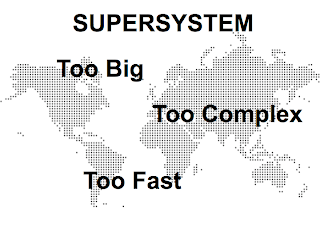
This could occur in the short run. It looks like an attractive and safe answer. But we'll soon discover that without a sophisticated network of systems which evolved because they provided huge benefits outweighing their costs, much of the charm of retrenched civilization fades rapidly. I note the Amish make use of MRI's for example, giving rise to a small industry of folks who shuttle non-driving Amish to hospitals. The point is the astonishing benefits we have developed by slowly providing more linkages between people around the world will be sharply missed once the Great Fallback begins.
Like locavores who are faced with mostly grim root vegetables in February and March, the knowledge that New Zeland apples used to be down at the grocery cannot be unlearned. Even should we choose to retrace our steps economically and culturally, the same huge payoffs will be dangling there for those who re-offer a chance to markedly improve standards of living with just modest investment in technology or integration.
Farmers will be under pressure to embrace agrarian production to fit with this decentralized mythos. A growing sector will serve these communities, but I seriously doubt whether the world can begin to de-urbanize and un-link enough to markedly change our sytems of economics and basic living.
More likely is the emergence of stronger and more independent members of national or international systems. By pushing more decisions and innovation to lower levels, institutions and even governments could better counter the inherent instability of massive entities capable of massive failures such as we have seen. In short, I think we will see new ways to aggregate and achieve economies of scale without stripping smaller components of risk or reward.
We may be about to franchise our culture.
[All Posts]
Just in time for Christmas, this vision of the future by Robert Paterson after a weekend of conferring with colleagues:
- That there is no soft landing. We are not in a recession. We are not even in a depression. We are at the end of an era. The Tipping Point is of course the financial collapse. The Vast Ponzi Scheme of our financial world - with the vast sums in the Derivative Market and the Credit Bubble all in effect lost - cannot be saved. There is not enough money in the national accounts to pull this back.
- The search for efficiency and the urge to consume has set us all up like a row of dominoes - there is no buffer, no resiliency. As one problem rises it causes another. As one solution is tried it drives another problem. We all pull back and the consumer economy stalls. The auto industry and credit firms feeds the media (40% of conventional advertising). Papers and TV and Radio networks, many subject to LBO's will have to fail as per the Tribune. Every sector will be laying people off. Sales of all things fall off a cliff - driving more business failures and layoffs. Cities and states that depend on sales tax and property tax and the credit markets can rely on none of these. So they too will have to lay off millions - thus making all the problems worse. National governments will be asked to save us all and of course cannot. As States and Cities get squeezed and cannot borrow, they will too lay off millions - teachers, firemen police. No one will be safe
- As all of this is happening - the web is also sweeping through all businesses and gutting all who made artificial scarcity the heart of their model. This would be enough to drive a revolution but now is only one aspect of a perfect storm. There is no time to feel a way into a new model. A new model has to be found in 2009 or your business will die from this alone.
- The world food system is exceptionally connected and tightly coupled. High fertilizer prices in 2008 will drive a food shortage in 2009. Inventories of grain are already low. The collapse of commerce and credit may risk food supplies in 2009. The 2008 rice problem was a harbinger for what is to come
[More]
I do not discount the possibility of the outcomes described above, but too many of them are forced to line up in one direction: decentralized societies rather than nations as the necessary - and not coincidentally, desired - answer. I have suspected for a while that cultural critic would use the financial crisis as justification for a return to more local forms of social organization, to "de-integrate" ("distintegrate" didn't sound right) away from monstrous institutions and especially globalization.
This could occur in the short run. It looks like an attractive and safe answer. But we'll soon discover that without a sophisticated network of systems which evolved because they provided huge benefits outweighing their costs, much of the charm of retrenched civilization fades rapidly. I note the Amish make use of MRI's for example, giving rise to a small industry of folks who shuttle non-driving Amish to hospitals. The point is the astonishing benefits we have developed by slowly providing more linkages between people around the world will be sharply missed once the Great Fallback begins.
Like locavores who are faced with mostly grim root vegetables in February and March, the knowledge that New Zeland apples used to be down at the grocery cannot be unlearned. Even should we choose to retrace our steps economically and culturally, the same huge payoffs will be dangling there for those who re-offer a chance to markedly improve standards of living with just modest investment in technology or integration.
Farmers will be under pressure to embrace agrarian production to fit with this decentralized mythos. A growing sector will serve these communities, but I seriously doubt whether the world can begin to de-urbanize and un-link enough to markedly change our sytems of economics and basic living.
More likely is the emergence of stronger and more independent members of national or international systems. By pushing more decisions and innovation to lower levels, institutions and even governments could better counter the inherent instability of massive entities capable of massive failures such as we have seen. In short, I think we will see new ways to aggregate and achieve economies of scale without stripping smaller components of risk or reward.
We may be about to franchise our culture.
[All Posts]
Saturday, December 20, 2008
Building my Deep Think Future™: Dot #1...
As is customary for me this time of year, I take occasional breaks from eating Christmas cookies to ponder the future of our farm, and strengthen the rum-eggnog ratio. This year is more fun than usual since we have stumbled into a world where assumptions seemingly have no bounds and imagination cannot find many constraints which have not already been breached.
What follows are some items that comprise my background for aiming my future plans. They may seem wildly disconnected, but we have learned from recent brain research that's one thing our brains do well - connect seemingly unrelated dots.
Dot 1: The Energy Environment
Consider these slides from the DOE EIA Annual Energy Outlook 2009:
From the summary you don't get the real sense of the scope of the change of outlook. But in the following charts observe the difference between the 2008 forecasts and the 2009.

While I don't fault them, one glance at the next chart says to me: We have no idea what oil prices could be.

However, between curtailed demand and biofuels, there is good news for those who despise importing oil. Note however, that this chart does not suggest where the imports will come from - a point frequently lost in the jingoistic oversimplified view of oil coming only from the Mideast.

Whether I like it or not, and to the deep concerns of the meat/dairy industries it looks like biofuels are being woven into a "given" for our energy future, despite the funky science and economics underlying them. As this perception of acceptance spreads via seemingly disinterested parties like EIA, political will to subsidize and grow the ethanol industry solidifies.

And as I have long believed, cellulosic biofuels will continue to disappoint. Inference: higher mandates for corn use will be accepted with decreasing resistance.

For the first time, energy demand is being seen as responsive to costs. My take: energy suppliers will be in fierce battle for market share. Oil companies may decide it's better to own some ethanol production than fight the farm lobby.

Some wild conjectures:
Again, I may not be crazy about my predictions, but I do have to compete in a world where they might come true.
Of course, this could all be the eggnog talking.
[John's World: All Posts]
As is customary for me this time of year, I take occasional breaks from eating Christmas cookies to ponder the future of our farm, and strengthen the rum-eggnog ratio. This year is more fun than usual since we have stumbled into a world where assumptions seemingly have no bounds and imagination cannot find many constraints which have not already been breached.
What follows are some items that comprise my background for aiming my future plans. They may seem wildly disconnected, but we have learned from recent brain research that's one thing our brains do well - connect seemingly unrelated dots.
Dot 1: The Energy Environment
Consider these slides from the DOE EIA Annual Energy Outlook 2009:
From the summary you don't get the real sense of the scope of the change of outlook. But in the following charts observe the difference between the 2008 forecasts and the 2009.

While I don't fault them, one glance at the next chart says to me: We have no idea what oil prices could be.

However, between curtailed demand and biofuels, there is good news for those who despise importing oil. Note however, that this chart does not suggest where the imports will come from - a point frequently lost in the jingoistic oversimplified view of oil coming only from the Mideast.

Whether I like it or not, and to the deep concerns of the meat/dairy industries it looks like biofuels are being woven into a "given" for our energy future, despite the funky science and economics underlying them. As this perception of acceptance spreads via seemingly disinterested parties like EIA, political will to subsidize and grow the ethanol industry solidifies.

And as I have long believed, cellulosic biofuels will continue to disappoint. Inference: higher mandates for corn use will be accepted with decreasing resistance.

For the first time, energy demand is being seen as responsive to costs. My take: energy suppliers will be in fierce battle for market share. Oil companies may decide it's better to own some ethanol production than fight the farm lobby.

Some wild conjectures:
- Suppose BP buys Verasun. For that matter, suppose Mobil buys ADM. From the point of view of who has money and who is grossly undervalued in the market, it's not unthinkable. Oil companies would thus participate in the only growing domestic supplier share. I think it could be one of the best outcomes for this market, and would certainly blow some farmer minds to depend on an oil company for their corn check. It would also quiet farmer "Big Oil" rants, at least in 100-mile circles around ethanol plants.
- Since we have been stunned by the first drop in electricity consumption EVER in the US, what if saving energy becomes a fad that escapes the greenies to the general public? Now add in GHG emission rules that make this shift in thinking even more favorable. I think the demand changes in this presentation will be expanded in future forecasts. At that point energy suppliers will really love market share protection afforded by mandates, ergo more fuel for the ethanol industry.
- With domestic NG production rising, domestic NH3 production looks better and better. (We'll look at production issues at a later time).
- Could some serious money be made here at N 2100th Street by betting on a change in energy usage and production, not to mention energy politcs? Seems like it to me. at the very least, some serious competitive prressures could be pre-empted.
- While the biofuel industry is busy fending off critics (like me) a case can be made that succeeding beyond their wildest imagination could be the more ominous outcome. If biofuels grow to the extent projected here, the slam-dunk nature of their quasi-governmental status will be a commodity of great value in the market. And this value could be apparent far earlier than the recovery of confidence in the general equity markets. Like the flood of government-backed debt in the market, I think government-mandated equity, such as ethanol plants represent will be golden. This could happen overnight as part of the infrastructure stimulus and energy plans of the new administration. I think some combination of these effects is very likely.
- Can grain merchandisers like Cargill, who have largely avoided the ethanol business to prevent conflict with their feed/food customers end up big losers? Oh, yeah.
Again, I may not be crazy about my predictions, but I do have to compete in a world where they might come true.
Of course, this could all be the eggnog talking.
[John's World: All Posts]
Wednesday, October 22, 2008
What's next?...
The credit crisis has become boring. Even x-hundred point moves in the Dow are ho-hum now. Been there, lost that. So after we get this pesky election off the news cycle what could happen next in this wacky year of 2008?
Lot o' layoffs. While credit may be starting flow, it ain't cheap or easy. And spending is plummeting, so look for a wide array of cutbacks in employment.
Second, we will have a period of interest rate and lending turmoil. For example, my small bank is in excellent shape, doing what small banks do: taking deposits and making loans. They also have plenty of money for their regular customers - and even more if they raise their capitalization by participating in the goverment bailout. When I talked with my banker yesterday, I pointed out the irony that as the Fed lowered interest rates - and effectively the prime rate - the interest on my variable was dropping. Meanwhile across town the Farm Credit System is having a tough time flogging their AAA bonds to investors causing their interest rates to jump upward. Unsurprisingly, she was way ahead of me.
This outcome was easily predicted - heck even I saw it coming. But suddenly the big advantage FCS had over banks - access to unlimited capital - has become their Achilles heel. Until credit worries perk up interest in commercial and quasi-government paper, they will struggle with competition.
One player I look to step up big-time is Rabobank. Their extremely conservative Dutch manangment (trust me I know - my father-in-law was Dutch and pretty ummm, tight) has them in a strong position just when they are poised to woo the top tier of ag loans.
My banker has already made it clear that any new lines of credit probably won't be my usual x points below prime. In fact, I anticipate an interest rate floor, as the Fed could to take the prime to dang near zero.
Bottom line, the dating game between lenders and farmers has just entered a wild new phase. Personally, I'm buying candy for my banker. And I may start taking back the dozens of free pens I been filching. There will strong competition from those whose credit is rationed and interest costs are jumping upward. Savvy borrowers are doubtless in her office now trying to get their dirty paws on my loan money, I bet.
Creidt may be easing, but it won't spring back instantly. Some signs are hopeful and talk is increasing of another stimulus package. What to wish for: depreciation breaks, personal exemption, and the Holy Grail: investment tax credits for everything! What we'll more likely get: stupid old roads and bridges.
More thoughts about how the New Financial Order will look from Route 2 as inspiration strikes.
The credit crisis has become boring. Even x-hundred point moves in the Dow are ho-hum now. Been there, lost that. So after we get this pesky election off the news cycle what could happen next in this wacky year of 2008?
Lot o' layoffs. While credit may be starting flow, it ain't cheap or easy. And spending is plummeting, so look for a wide array of cutbacks in employment.
When the dot-com and housing bubbles burst, it was easy to see what types of jobs would disappear. But these days as nervous lenders cower and credit contracts, virtually every industry is likely to be scathed in the widely predicted downturn starting this autumn. Nearly every business relies on credit to operate—just as they need customers to have spending power.How could this affect agriculture? First, by reducing the usual off-farm income that supports many smaller operations. My take is this will make consolidation offers from neighbors - especially if employment is included - look pretty good. Remember the top goal (whether many acknowledge it or not) for many small operators is to live where they now live, not how they make their money.
With lending trimmed, and companies and consumers tightening their belts , jobs will be cut across broad swaths of the economy, from the tech sector to investment banking, and from manufacturing to soft drinks.The four-week moving average of U.S. jobless claims hit its highest point in seven years, the Labor Dept. reported on Oct. 20. The average number of new jobless claims rose to 483,250 for the week ended Oct. 11, the highest since 2001. September's unemployment rate was unchanged at 6.1%, but economists generally predict the labor picture will deteriorate in coming months.[More]
Second, we will have a period of interest rate and lending turmoil. For example, my small bank is in excellent shape, doing what small banks do: taking deposits and making loans. They also have plenty of money for their regular customers - and even more if they raise their capitalization by participating in the goverment bailout. When I talked with my banker yesterday, I pointed out the irony that as the Fed lowered interest rates - and effectively the prime rate - the interest on my variable was dropping. Meanwhile across town the Farm Credit System is having a tough time flogging their AAA bonds to investors causing their interest rates to jump upward. Unsurprisingly, she was way ahead of me.
In the last week, virtually every Farm Credit Association in the country has been forced to impose record, one-time hikes in operating credit and farm mortgage rates. Five-year adjustable mortgages for qualified customers at Louisville-based Farm Credit Services of Mid-America, for example, jumped to 7.35 percent this morning, up from 6.15 percent on Oct. 8. Libor-indexed variable-rate operating credit now runs 7.3 percent, up from 5.25 percent during the first week of October. For the moment, variable-rate operating loans (which flex with prime rates) are set at 5.4 percent. (See DTN's Ag Interest Rate Snapshot, updated daily on the Farm Business page.)
In e-mail messages, FCS of Mid-America's Treasurer Bill Lankswert said financial markets are undergoing more uncertainty than at any time since the Great Depression. The 30-day Libor rate is used to price short-term borrowing by many agricultural producers and agribusiness and "is an indication of costs for most other businesses in the United States," Lankswert noted. "In the past week, the rate peaked at 4.56 percent, up from less than 2.50 percent just two weeks ago. The increase in the Libor and other related rates mean that many borrowers will, or have already, seen a quick increase in short-term borrowing costs."
Omaha-based FCS of America prices its retail loans based on a slightly different formula, but customers who thought their operating lines bore some link to the nation's prime rate will be disappointed. "All of the normal benchmarks we have used to price loans have changed," said Stark, whose territory covers Iowa, Nebraska, South Dakota and Wyoming. "Even prime rates bear no relationship to our costs anymore. Borrowers who were normally charged rates of a half-point under prime may find themselves at a half-point or one point over prime now." [More]
This outcome was easily predicted - heck even I saw it coming. But suddenly the big advantage FCS had over banks - access to unlimited capital - has become their Achilles heel. Until credit worries perk up interest in commercial and quasi-government paper, they will struggle with competition.
One player I look to step up big-time is Rabobank. Their extremely conservative Dutch manangment (trust me I know - my father-in-law was Dutch and pretty ummm, tight) has them in a strong position just when they are poised to woo the top tier of ag loans.
While this will lead to higher margins, we will have to pay more attention to the funding than in the past. We must enter into reciprocal relationships with clients. This means that, while we have until now often been a primarily credit-driven organisation, we must now also focus on including savings and deposits in our client relationships.
Rabobank is in good shape. It is, in fact, rock solid. This is the result of 100 years of frugal banking. We have always ensured that we maintained extremely strong buffers. We have a Tier-1 solvency ratio of more than 10 percent and a well-diversified range of activities. The crisis does, however, demand that we realign our strategy for the Netherlands and abroad.
In the Netherlands we must seize opportunities primarily in the business market and in the field of private banking. In the international arena we must focus even more sharply on our core business, i.e. food & agri and sustainable enterprise (CleanTech). We must move forward with the expansion of retail in other countries, including intensifying our activities in developing countries. This forms part of our commitment to implement Raiffeisen’s mission in the year 2008. [More]
My banker has already made it clear that any new lines of credit probably won't be my usual x points below prime. In fact, I anticipate an interest rate floor, as the Fed could to take the prime to dang near zero.
Bottom line, the dating game between lenders and farmers has just entered a wild new phase. Personally, I'm buying candy for my banker. And I may start taking back the dozens of free pens I been filching. There will strong competition from those whose credit is rationed and interest costs are jumping upward. Savvy borrowers are doubtless in her office now trying to get their dirty paws on my loan money, I bet.
Creidt may be easing, but it won't spring back instantly. Some signs are hopeful and talk is increasing of another stimulus package. What to wish for: depreciation breaks, personal exemption, and the Holy Grail: investment tax credits for everything! What we'll more likely get: stupid old roads and bridges.
More thoughts about how the New Financial Order will look from Route 2 as inspiration strikes.
Saturday, February 23, 2008
The prediction problem (Episode 24)...
Grain markets have made fools of about 173% of all market advisers lately. Which has froozen many of us in our tracks and lowered our confidence in almost nay prediction. Is the future actually more unknowable than it used to be? How should we try to prepare for tomorrow?
Grain markets have made fools of about 173% of all market advisers lately. Which has froozen many of us in our tracks and lowered our confidence in almost nay prediction. Is the future actually more unknowable than it used to be? How should we try to prepare for tomorrow?
We all want to know what comes next. It would be great to know in advance if buying that stock, taking that job, or marrying that person is the right idea. But we can't. As Salman Rushdie wrote during his years on the run from the fatwa, "Our lives tell us who we are." We can't know for sure how things will turn out until they happen.Even this modest goal (identifying trends) is harder to do than say. But I think opportunity abounds now for those who are willing to make the effort, since so many of us have stopped trying.
But we can surmise the context in which the future will occur. We can aggregate early signals and make smart decisions based on them. Rather than calling outcomes, we're here to call trends, to cut through conflicting signals and discern the most powerful ones. We don't know which company will become the leader in multitouch devices, for example, but we've seen plenty of signals to support a contention that multitouch will be huge in the years to come. That's why I'm so excited about two just-around-the-corner events, TED and our own ETech: They give you a peek into the future, straight from some of the places where it's happening already. [More]
Saturday, February 16, 2008
Bubble-casting...
The flood of forecasts of an ag/ethanol "bubble" is in full spate now. Steve make some good points in his recent post:
So, if we assume these prophets are correct, should we take to the storm cellar now?
Hardly. I think one of the strange developments of our information-juiced global economy is the tendency for trends to last longer than we think they should. Just like most of us could recognize the dot-com and housing bubbles as unsustainable, both markets defied gravity far longer than we thought possible.
I can't offer any good reason for this "Wile E. Coyote" leg-pedaling-after-running-of-the-cliff-but-not-falling phenomenon. It could be that skeptics are finally converted after years of being wrong, fueling the last gasp of the bubble. I know I reluctantly invested in a tech fund in (wait for it) February 2000.
It could also be when early prediction do not come true right away, subsequent warnings are dismissed, and investors and farmers simply double down. I think that is the stage we are in right now.
Complicating such predictions is the deep involvement of an arbitrary (and irrational) economic force: the government. We simply have few historic examples to use as analogs for the curious effects of "thou shalt" economic regimentation.
For those reasons, I'm betting a good 3 years remain before forces collapse our little boom (although the earliest prediction I can find does date to 2004). I am also basing my plans on the remarkable impotence of the livestock and policy reform groups to have any discernible effect on the new farm bill. (I don't mean to be unkind - I stand with them and gave it my best shot to get the government to stop sending guys like me money.) But when legislators from Western states shaft the cattle industry, what use is the NCBA?
Consequently, I am less persuaded about the immediacy of a reality intrusion. During that "air-pedalling" interim, serious money can be made. The upshot is cash rent contracts moving on upward but ending around 2011, and an expectation for $10,000/A prices for 200-bushel corn ground in I-states.
I reserve the right to adjust my outlook (before I tell you guys, of course). And of course, my opinions are for what I think will work in Prairie Township - I do not farm outside my neighborhood, and thus only "threaten" folks I live next to. My opinions are even more useless elsewhere therefore.
All operators will place their bets on when they think this bubble will burst. Some will do it formally with a plan, and many will vote to embrace denial by making no plan at all.
Oddly, this is not a useless strategy, I think. Most farmers will survive to see the other side, and if you are not in the lowest part of the competitive spectrum, you should be one of them. Some sort of plan could maximize your outcome on the way down however.
The flood of forecasts of an ag/ethanol "bubble" is in full spate now. Steve make some good points in his recent post:
So you’ve got the bubble. You’ve got the mood of the country. You’ve got a public with more stuff than anybody ever thought anybody would ever have and they’re demanding more. I don’t THINK I worry about a new Dust Bowl. I THINK that with modern technologies and knowledge—no-till and minimum till and sweeps instead of disc plows—we can avoid that part of the Depression. If, that is, there is enough money in farming to pay for chemicals and fuel. But it’s still worth your time to get a copy of Mr. Egan’s book. He didn’t get much into how good things were for farmers during the 20’s, but he sure did a good job on the bleakness of the 30’s. It might be a good thing to read as you consider how much money to borrow to buy more of this high priced land. Or those $1,200 cows, for that matter. And not to tut-tut, but you should certainly read it before you buy a $399,000 house in town. [More]He is far from alone. Some ag economists have numbers to back up the "bubble" label.
It is not a case of if, but when, the bubble bursts suggests Iowa State economist Bruce Babcock in the winter issue of the Iowa Ag Review. He says high prices are their own worst enemy because more profits invite more competition and more production. That means lower prices. Babcock says we may have high corn prices now, but in the past 50 years there have only been two occasions when corn prices were high in successive years. Short global crops did the trick in 1973-75, and from 1979 to 1984 prices were kept up with drought and farm policy. [More via farmgate]I don't dispute the call, but I have learned to be skeptical about the timing. Oracles started calling the 2000 NASDAQ crash in 1995, and the stern warnings about the real estate bubble can be traced back to at least 2002. About 18 months prior to actual evidence of the bubble bursting, the jeremiads became a cottage industry.
So, if we assume these prophets are correct, should we take to the storm cellar now?
Hardly. I think one of the strange developments of our information-juiced global economy is the tendency for trends to last longer than we think they should. Just like most of us could recognize the dot-com and housing bubbles as unsustainable, both markets defied gravity far longer than we thought possible.
I can't offer any good reason for this "Wile E. Coyote" leg-pedaling-after-running-of-the-cliff-but-not-falling phenomenon. It could be that skeptics are finally converted after years of being wrong, fueling the last gasp of the bubble. I know I reluctantly invested in a tech fund in (wait for it) February 2000.
It could also be when early prediction do not come true right away, subsequent warnings are dismissed, and investors and farmers simply double down. I think that is the stage we are in right now.
Complicating such predictions is the deep involvement of an arbitrary (and irrational) economic force: the government. We simply have few historic examples to use as analogs for the curious effects of "thou shalt" economic regimentation.
For those reasons, I'm betting a good 3 years remain before forces collapse our little boom (although the earliest prediction I can find does date to 2004). I am also basing my plans on the remarkable impotence of the livestock and policy reform groups to have any discernible effect on the new farm bill. (I don't mean to be unkind - I stand with them and gave it my best shot to get the government to stop sending guys like me money.) But when legislators from Western states shaft the cattle industry, what use is the NCBA?
Consequently, I am less persuaded about the immediacy of a reality intrusion. During that "air-pedalling" interim, serious money can be made. The upshot is cash rent contracts moving on upward but ending around 2011, and an expectation for $10,000/A prices for 200-bushel corn ground in I-states.
I reserve the right to adjust my outlook (before I tell you guys, of course). And of course, my opinions are for what I think will work in Prairie Township - I do not farm outside my neighborhood, and thus only "threaten" folks I live next to. My opinions are even more useless elsewhere therefore.
All operators will place their bets on when they think this bubble will burst. Some will do it formally with a plan, and many will vote to embrace denial by making no plan at all.
Oddly, this is not a useless strategy, I think. Most farmers will survive to see the other side, and if you are not in the lowest part of the competitive spectrum, you should be one of them. Some sort of plan could maximize your outcome on the way down however.
Wednesday, January 02, 2008
Think you're bullish?...
Somebody needs to turn the hose on the boys on Wall Street pushing commodity funds. I think their brains are overheating.
Still, $14 beans?...
Somebody needs to turn the hose on the boys on Wall Street pushing commodity funds. I think their brains are overheating.
Rising wealth from Shanghai to Sao Paulo is leading to better diets and straining corn and soybean supplies just as record energy prices boost sales of biofuels. Even after rising 17 percent in 2007, corn costs about $2 a bushel after adjusting for inflation, compared with a $7.80 high in 1974.I'm always a teensy bit skeptical of investment bankers predicting my future. After all, Goldman-Sachs needs to be selling something and the other stuff they got isn't looking so good right now.
``We are in the early stages of a rally that could last 20 years'' in agriculture, said Christopher Wyke, product manager at London-based Schroders Plc, which manages $3.5 billion in commodities and is buying more corn and soybean contracts while reducing energy holdings. ``Prices are historically cheap.''
Not since the Soviet Union harvest failures of the 1970s have food prices risen so quickly. European Central Bank President Jean-Claude Trichet said Dec. 19 that the region faced a ``more protracted'' period of elevated inflation than expected because of food and oil prices. [More]
Still, $14 beans?...
Sunday, December 30, 2007
How bad is it?...
A. Really bad.
B. Not so bad
So how are you betting? My guess is most farmers are mildly amused bystanders, and will be until a crisis forces some change in farm policy via subsidies or energy mandates.
As for the credit crisis, I believe it will get much worse, and interest rates could fall below the historic lows of just a few months ago.
A. Really bad.
As the credit paralysis stretches through its fifth month, a chorus of economists has begun to warn that the world's central banks are fighting the wrong war, and perhaps risk a policy error of epochal proportions. [More]
B. Not so bad
As the U.S. savings and loan crisis worsened in the 1980s, analysts tried to top each other's estimates of the debacle's cost to the federal government. Much the same thing is happening now with losses linked to subprime mortgages, with figures of $300 billion to $400 billion being bandied about. A more realistic amount is probably half or less than those exaggerated projections -- say $150 billion. That's hardly chicken feed, though not nearly enough to sink the U.S. economy. [More]
So how are you betting? My guess is most farmers are mildly amused bystanders, and will be until a crisis forces some change in farm policy via subsidies or energy mandates.
As for the credit crisis, I believe it will get much worse, and interest rates could fall below the historic lows of just a few months ago.
Predictions for 2008 (Load #3)...
Environmental issues:
Movies:
Technology (IT):
Which party will take the White House?
From the Iowa Electronic Markets (which has been shown to be remarkably accurate)

The Top 8 Health Issues
Environmental issues:
"Green" Continues to Grow: Public health and environmental concerns will remain a major issue. Continued attention on global warming, lead-based paints and the contamination of goods will drive businesses toward environmentally friendly packaging, recyclable products and the enforcement of trade regulations pertaining to the use of toxic electrical and electronic components. The concept of having a green supply chain will move from being a public relations strategy to a necessary means of deriving real economic value and improving compliance. As companies focus on supply chain and product lifecycle management initiatives in this environmental light, concepts that will be embraced include the designing of products derived from recycled materials; striving for "zero waste" from a product at end-of-life; and employing sourcing and fulfillment strategies based on less fuel consumption and the environmental practices of supply chain partners. [More]
Movies:
June 20: Myers is back with "The Love Guru," his first grown-up comedy since 2002's "Austin Powers in Goldmember." But he must topple Carell in Warner Bros. adaptation of "Get Smart." Advantage: "The Love Guru." [More]
Technology (IT):
Windows XP's Reprieve[Many more tech predictions here]
Microsoft will announce an extension until the end of 2008 for Windows XP availability, instead of cutting it off on June 30.
In September '07, the company pushed the extension from the end of January until June after corporate users complained. Not to mention that many companies had decided to put off moving to Vista. The migration will continue to be slow for at least the first half of 2008. [More]
Which party will take the White House?
From the Iowa Electronic Markets (which has been shown to be remarkably accurate)

The Top 8 Health Issues
6. Michael Pollan It was difficult to discuss food this year without bringing up Michael Pollan, whose bestselling book "The Omnivore's Dilemma" hit a nerve in the debate about our food system. By the end of 2008, we could be saying the same of "In Defense of Food: An Eater's Manifesto". Set for release on Jan. 1, Pollan's newest book follows up on a New York Magazine article from 2007 and argues that we're focusing too much on individual nutrients and losing site of the value of -- and delight in -- real food. Pollan's American paradox -- "the more we worry about nutrition, the less healthy we seem to become" -- is made all the more interesting by the increasing popularity of functional foods, or foods that are said to have added health benefits, with consumers and the food industry. [More]
Subscribe to:
Posts (Atom)