Saturday, February 05, 2011

It's not working that well...

The way it is. It remains a brutal and slow slog for health care reform, now in its ugliest political phase. But reform of access to health care is just one aspect of correcting the problems of a system that is far too costly and far less effective than it could be.

One reason for the ineffectiveness is the powerful profit motive influence on medical research. It's not a inherently bad, but this is what you get when there are no cost controls from either free market forces or regulation: sloppy reports and even sloppier media coverage.
If you follow the news about health research, you risk whiplash. First garlic lowers bad cholesterol, then—after more study—it doesn’t. Hormone replacement reduces the risk of heart disease in postmenopausal women, until a huge study finds that it doesn’t (and that it raises the risk of breast cancer to boot). Eating a big breakfast cuts your total daily calories, or not—as a study released last week finds. Yet even if biomedical research can be a fickle guide, we rely on it.
But what if wrong answers aren’t the exception but the rule? More and more scholars who scrutinize health research are now making that claim. It isn’t just an individual study here and there that’s flawed, they charge. Instead, the very framework of medical investigation may be off-kilter, leading time and again to findings that are at best unproved and at worst dangerously wrong. The result is a system that leads patients and physicians astray—spurring often costly regimens that won’t help and may even harm you. 
...
But at NIH Ioannidis had an epiphany. “Positive” drug trials, which find that a treatment is effective, and “negative” trials, in which a drug fails, take the same amount of time to conduct. “But negative trials took an extra two to four years to be published,” he noticed. “Negative results sit in a file drawer, or the trial keeps going in hopes the results turn positive.” With billions of dollars on the line, companies are loath to declare a new drug ineffective. As a result of the lag in publishing negative studies, patients receive a treatment that is actually ineffective. That made Ioannidis wonder, how many biomedical studies are wrong? [More of an important article]
Compared to medicine climate science is a model of clarity. But the linkage between research results and product sales is so strong, and as public research funds constitute a smaller part of the support, this problem could get much worse.

Much of the problem comes from our collective math anxiety. We want certainty, not probability statistics. If more of us understood what a standard deviation meant, we could scrutinize flash reports from medical research with more expertise and parse out the meaning for our lives.

Which leads me to this medical report.
Researchers said they have identified a combination of four genes that appear to play a critical role in determining whether prostate cancer in its early stages will go on to become an aggressive, lethal disease.
The information could enable doctors and patients to make better decisions after the diagnosis of prostate cancer, a disease that is commonly overtreated today, researchers said. [More]
It turns out the sample was small (400) and long term studies have yet to be completed.  But my guess is when a test for these genetic markers is available in a few years, guys my age will all be getting one. While I hope it helps and stops the unnecessary interventions now common, it will likely be my sons who really benefit, and only after more and larger tests are completed.

One reason this misapplication of research problem exists could be the self-serving impatience of the aging Boomers. And impatience is very expensive. However it is done, America must come to grips with the idea now clear in other areas of economic activity: you can't have everything. Our system currently tries to finesse that rule, and quietly ration care by capacity to pay or by employer.


Friday, February 04, 2011

And even more of us...

Suddenly become uninsurable. The rapid advancement of genetic testing has bioethicists in a quandary.
There are lots of different answers to Pence’s question, why test for incurable diseases like Alzheimer’s disease? Now that the tests are becoming available, researchers can identify people who are at higher risk of falling ill earlier, and enroll them in studies to uncover how the disease progresses. This will also allow scientists to enroll subjects in clinical trials earlier for new drugs aimed at preventing the disease.
Testing is not just about therapy. People can also use the information to help plan their futures. Perhaps they will drop out of the corporate grind and become Caribbean sailing captains. Or they will arrange their affairs so that they can receive good care when they do fall ill. Of course, some people really may not want to know. In which case, they are perfectly free to not take the tests. The only people who seem especially overwrought and unable to handle the results of genetic testing are bioethicists. [More]
I find interesting the intellectual debate over whether to tell patients of bad test results, but still think the problem will be dwarfed by the larger issue of making the individual health care market virtually non-existent, should health care reform be dismantled. The thinking the status quo was good enough ignored some unsustainable trends, not only in health outcomes and costs, but mostly in coverage.

It appears clear that this recovery will not be providing great jobs with full coverage, and the trend for workers even with insurance to pick up more of the tab will dampen wage growth and the economy for the foreseeable future.

We may reach the tipping point of shrinking coverage faster than we thought unless "repealers" begin to ponder how fast traditional insurance is failing the population.
What to do...what to do?...

A loyal reader sends in his stop-action video of the storm in LaGrange, IL.


Although I had to travel for USFR Thu and Fri, the layer of ice still puts the kabosh on travel.  On our country roads if you slip off the crown in the middle of the road, you tend to slide ever so gently into the shiny ditch.


[Thanks, Sterling]

Thursday, February 03, 2011

What up with the IRS?...

For all of you who do your taxes, and mail out the 1099's, you may have noticed this year the addresses began with "Department of the Treasury, Internal Revenue Service, Kansas City, etc."

The DOT part is new. Why?

Maybe the IRS is getting techy about the cranks who claim they really, really aren't government officials.  I was unfamiliar with this particular conspiracy genre, so here's some disturbingly Beckian rant for your frigid morning.
The Internal Revenue Service is not an agency of the United States government. It is true that not only can it NOT be found in Title 31, but it is nowhere to be found in the entirety of Title 5 U.S.C.

Congress THOUGHT it created it but it didn't. Just look at the 1100 manual and it tells you so. Congress only created the Commissioner's Office. He then hired the private collection agency people and used them as the tax collectors. In fact, I defy you to find any IRS employee listed as an Employee of the United States Government with a United States Employee Identification number that has been hired by any District Director in the country. Now I suggest you look at 27 Code of Federal Regulations Section 250.11 and therein you will find the definition of "Revenue agent." That definition reads "Any duly authorized Commonwealth Internal Revenue Agent of the Department of the Treasury of Puerto Rico."

I now refer you to the "Secretary" described in 26 U.S.C. 6301. Does it not state, "The Secretary shall collect the taxes imposed by the internal revenue laws?" Yes it does. Now Congress mandated this by 68A Stat 775 and you cannot disagree. Does not 26 U.S.C. state that this "Secretary" may make a return based on the information he has if a person does not make a return? Yes it does. Does not 26 U.S.C. 6001, 6011 and 6012 refer to this "Secretary?" Yes it does.

Now, if the Revenue agent decides to prosecute, he approaches the Attorney General and this "Secretary" as noted in 26 USC 7401 to prosecute upon concurrence between both the Attorney General and this "Secretary," is this not correct? Yes it is and all the above is undisputable. Is it now contrary to any rational man that this "Secretary" can only be one person and not many. [And on it goes...]
This kill-the-taxman-and-our-problem-will-be-over thinking is a subset of the thoroughly disproven "starve the beast" strategy of curbing government spending.  As Drum points out it, actually makes spending easier.
Conservative Steve Chapman summarizes recent research showing that cutting taxes does not, in fact, "starve the beast." That is, it doesn't motivate the public to demand lower federal spending as deficits rise. In fact, it does just the opposite:
Forced to pay for everything they get, right away, Americans would undoubtedly choose to make do with less. But given the opportunity to party now and pay later — or never, if the tab can be billed to the next generation — they find no compelling reason to do without.
Think of it this way. If you want people to consume more of something, you reduce the price. If you want them to consume less, you raise the price. For most of the last 30 years, federal programs have been on sale, and they've found lots of buyers.
True enough. The Republican Party has basically taught Americans that deficits don't matter. We can have all the government services we want and there's no need to pay for them. Under the circumstances, who wouldn't want more government services? [More]
The larger problem for the IRS is budget cuts. I mean, who doesn't want to make tax evasion easier? 


Yeah, that will help close the deficit...

Wednesday, February 02, 2011

OK, I'll admit I'm a little cabin crazy...

But even I had to stop eventually after scanning dozens of Better Book Titles.

My favs (so far):


 Moby Dick


 A Christmas Carol


 The Giving Tree


Beowulf
After 12 hours...

Our power came back on. I wept like Michael Landon.

But other than that, the Big Storm has not been as advertised right here, and I think I know why.

[More] [Click to embiggen]

Tuesday, February 01, 2011

Uh-oh...

Just had a 5 second power interruption. Normally, if they power drops for more than 2 seconds it means we're on our own, but maybe we just dodged a bullet.

The forecast for Edgar County is not a happy one, however. We have about 1/2" ice on the ground and 1/4" on the trees.


Our main computer is on an emergency bus powered by our automatic generator (possibly the best $3500 I have ever spent) so I'll probably keep posting for something to do.  But this could be a bad one for folks in my area. Aaron and I were speculating about trying to move snow with ice under the drifts.

Be careful out there.
Can't buy a break...

Jeez - the Australians in Queensland can't get seem to find the end of the tunnel.  Or storm.
Still cleaning up from devastating floods that killed some 32 people, residents along a wide swath of Queensland’s north coast are now being told to brace themselves for what may become the largest cyclone the “sunshine state” has ever faced.
Cyclone Yasi is expected to slam into the Queensland coast around 1 a.m. Thursday local time, packing winds of more than 250 k.p.h. (155 m.p.h.). This puts it on a par with the force of Hurricane Katrina, which devastated New Orleans in 2005 and clocked winds of 175 m.p.h., before weakening as it neared the coast.
...
Yasi is also threatening around a third of Queensland’s sugar cane crop. Australia is the third largest sugar exporter in the world and Queensland grows more than 90 percent of the country’s sugar cane. The state’s banana crop, another major earner, is also expected to be severely impacted. This latest hit comes as Queenslanders clean up from floods that have caused some $5.6 billion in damage. [More]
For me there is something terribly wrong about center pivot fields underwater.


OK. Now imagine you are a Chinese government official and you source food supplies for your increasingly wealthy and expectant citizens. One of your best sources can't get out from under clouds (Australia) , another came up short on their corn crop (US) and the rest are fighting La Nina-related production problems.

Now you turn on TV and see popular uprisings triggered in large part by people who want cheaper and better food, and expect their government to make it happen.

I would do three things:
  1. Root for appreciation in the value of the yuan to boost my buying power overseas.
  2. Keep my domestic inventory numbers very secret (assuming I even believe them).
  3. Buy at any price to get what is needed. Those dollars stacked up in Beijing won't be getting stronger anytime soon anyway.
*** Repost: This oughta be good (II)...

This is a re-post from 10/26/2010 when Todd Neeley originally published his research on oil vs. ethanol subsidies. I just got my copy of Progressive Farmer and he ignored all counterarguments and simply arranged the answer to please his audience, I think. My conclusion below, using his numbers, still better compares the two government policies. [More here]

I have been following The Ethanol Blog by Todd Neeley as he wades through the complex maze of subsidies for ethanol and oil.  His breadth of coverage is admirable, even if his blogging style is distracting, not to mention finding your way past the subscription gates.  Here are links to the first three posts anyway:   2  3

My comments about the latest two installments.

Much space is given to the March study by Bruce Babcock at CARD, although irritatingly, the actual study (pdf) is not linked.  However, the report is accurately reflected and answers one of the questions I had posed about the value of the mandate (RFS).

Babcock said it would be easy to figure out the level of subsidy from RFS if VEETC wasn't there by examining the price of renewable identification numbers, or RINS. These are the numbers assigned to each gallon of renewable fuel to allow the EPA to track usage of those fuels.
Fuel blenders are required to either blend a certain amount of ethanol or to purchase those identification numbers from blender companies that have met RFS requirements and have "excess" renewable fuel to sell. The RIN system works to ensure industry-wide compliance with the RFS.
"All you would need to do would be to look at the RIN price to look at how much support is being received by the ethanol industry. But with VEETC, the RIN price is as much as 45 cents per gallon lower than what it would be," said Babcock.
With the influence of VEETC, the RFS provides little support. With VEETC removed, Babcock said, the RFS would be worth about 30 cents per gallon, or about $3.9 billion, based on the 2010 RFS of 12.95 billion gallons.
Koplow said the RFS will become more valuable every year on its way to the mandated 36 billion gallons of production in 2022. [More]
[Curiously, we have no way of knowing who this "Koplow" guy is, but I appreciate his input.  Actually he is identified in the third? fourth? post.]

This value for the mandate seems low to me, but I can find no fault in Babcock's logic other than at the extremes: low oil prices, for example. 

Also the original study referenced regarding oil protection costs is here. The report does answer my speculation about the importance of Israel vs. oil.
Next, the CRS (1992) claims that the U.S. military salso is concerned with the security of Israel. But we see no evidence of a major military concern for Israel per se, independent of concern about energy security. In the first place, the Military Posture statements cited above make it clear that the JCS cares about Israel only in the context of the Arab-Israeli conflict. On account of its oil interests in the Gulf, the U.S. does want the region to be stable, and to forestall and resolve Arab-Israeli conflicts. As cited above, the Joint Chiefs of Staff are clear on this. Thus, U.S. military planners care mainly about regional stability – because of the region’s oil – and not so much about Israel per se. We believe that, if the Middle East had neither oil nor strategic importance, the U.S. would not maintain a significant military presence in the region solely to help protect Israel. Fuller and Lesser (1997) agree, stating that “at this point, Israel’s security, however important, does not represent an extra dimension of U.S. Gulf Policy” (p. 45).11 [Same]
This will come as harsh news to AIPAC, I'll bet.

However, the authors of the study warn against using their analysis to do, well, what this series is doing - numerical comparison.
Our analysis of these steps generally is illustrative, not rigorously quantitative. We estimate that there were no oil in the Persian Gulf, then U.S. combined peacetime and wartime defense expenditures could be reduced in the long run by roughly $27 to $73 billion per year (in 2004 dollars). If all motor vehicles in the U.S. did not use oil, U.S. military expenditures could be reduced by $6 to $25 billion per year, or $0.03 to $0.15 per gallon ($0.01 to $0.04 per liter) of all motor fuel. [Same]
The next installment (I think it's next, the numbering is not readily apparent) does yeoman work on summarizing all the possible "subsidies", and again the writing style is puzzling.  The data begs for columns.  Hidden in plain sight are the per-gallon totals I think more accurately reflect subsidy levels, except for one thing: they compare apples to fruit salad.

The oil industry, unlike ethanol, has more products in addition to gasoline.  To allocate all the subsidies to that one product makes no sense.  Here is what you get from a barrel of oil.


[Click to enlarge] [Source]

So if we use 51% as gasoline's share (allocated below), here is what the subsidy levels per gallon look like, using Todd's numbersI think this is fair because Todd counts home heating oil subsidies, for one example, in the mix, which don't have anything to do with the 140 B gallons of gasoline he divides by.  The last column using the energy difference between gasoline and ethanol (80%) for an energy equivalent number.


DTN Allocated Allocated
$B $/gal $/gal $/eqiv gal
Oil (low)* 133.2  $0.96  $0.49  $0.49
Oil (high)* 280.8  $2.01  $1.03  $1.03
Ethanol 16.1  $1.24  $1.24  $1.55

[*These labels were stupidly reversed in the original post] 


It is fair to report the huge total number oil gets, but as I noted before, most farmers still believe the bigger you are the more subsidies you deserve.  And oil is a really big industry.

So for this observer, I think the idea oil is getting "more" subsidies is an artful arrangement of fact.  At the very least, oil gives the taxpayer more energy bang for his/her subsidy buck.
 
Junkbox, Episode BWAAHAAHAA...

So I'm glued to my phone trying to outwait thousands of other fliers trying to cancel/change flights through ORD, and here's what I've surfed up:
Total telephone time invested: 1:45.

My ear hurts, but I got a full refund (OK, travel credit) with no fee.

Update: It seems Twitter made this happy outcome possible.

Sunday, January 30, 2011

It's about food...

More than we think here in the US.  Here is what Egyptians are facing with their household finances.

[Source]

In November, overall inflation in Egypt topped 8.58 percent for the year, its highest level in 19 months. But food inflation has been much more pronounced.
Fitch, in downgrading Egypt's outlook to negative today, specifically cited the high food inflation, which it said was running at about 17 percent a year. The main drivers of food inflation are meat and sugar. [More]
My guess is the food-fuel debate is about to get much hotter. And any hint of trouble during planting season will not be helpful to the current ethanol pseudo-business model.

Saturday, January 29, 2011

Consumption ideas...

Worth pondering. [It has nothing to do with her easy-to-look-at-ness]


I have been looking for indications of how we might start rebuilding trust to make our culture and economy work better. Perhaps, as the speaker suggests, it will be by bypassing many of our current institutions with peer-to-peer connections.
Wedding rings...

For engineers.


[Thanks, Dave]
Point-counterpoint...

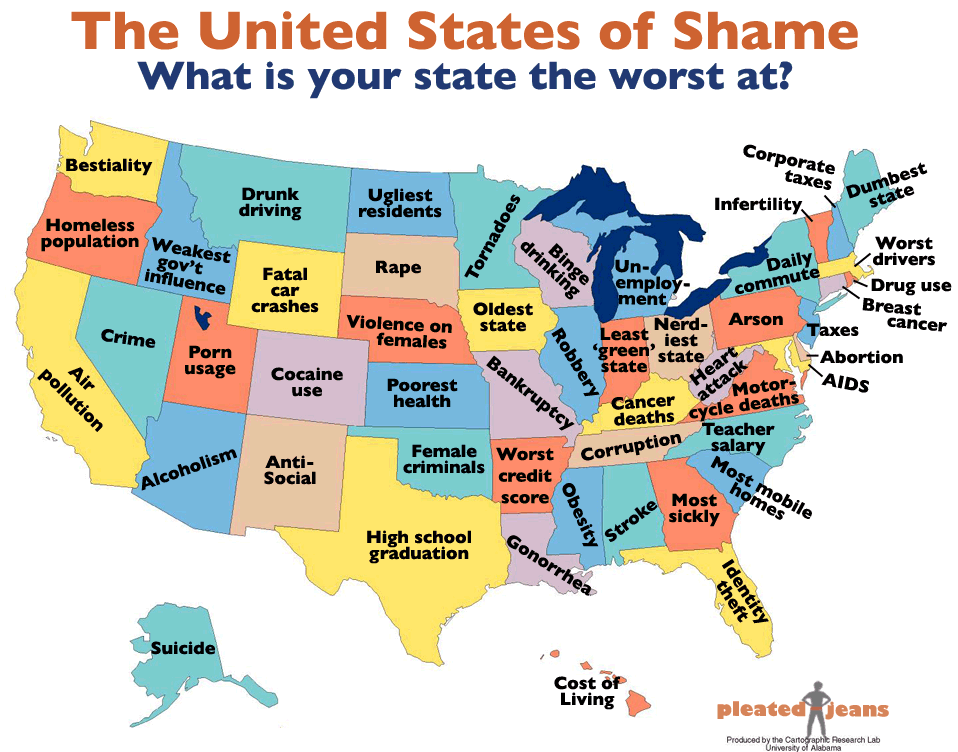
When this map hit the blogosphere, it was widely cited as both amusing and trivial.


[Source] [Click to embiggen]

It prompted this comeback:


[Source] [Click to...you know the drill]

Two points:
  1. There are some obvious value judgments in both.  Mobile homes are shameful? Meh.
  2. There are some curious coincidences as well.  Utah: porn usage and wellbeing, for example.
Add your own observations below.

[via sullivan]
The real fight over the Internet...

Several coincidental (or maybe not) developments underscore the growing importance and vulnerability of the Internet in virtually every aspect of modern life. 

First, from Egypt, note the usual pattern of capturing the TV and radio stations was preempted by a government shutdown of the nations ISP's. 
The domino-like takedown of the ISPs indicated the government didn't have a master shutoff switch, but ordered each company to flip their in-house switches.
"This sequencing looks like people getting phone calls, one at a time, telling them to take themselves off the air," James Cowie, chief technology officer for Renesys, said in the company's blog. "Not an automated system that takes all providers down at once; instead, the incumbent leads and other providers follow meekly one by one until Egypt is silenced."
Vodafone Egypt issued a statement saying all mobile phone operators had been ordered to suspend services in selected areas. "Under Egyptian legislation, the authorities have the right to issue such an order and we are obliged to comply with it," the company said.
The Egyptian government is not the first to shutdown the Internet during political unrest. The Burmese government ordered a takedown in September 2007, and Nepal severed all international Internet connections after the government declared martial law in February 2005.
The fewer the ISPs, the easier it is for governments to impose a blockade. Burma, for example, had only two ISPs in 2007. Shutting down the Internet in developed nations, such as the U.S., would be far more difficult, if not impossible, because of the many ISPs operating in the countries with networks linked to other networks inside and outside the borders, experts say. [More]
Now stay with me, as one commenter thinks this presages a new pattern for - of all things - the NFL.
Facebook and Twitter may get credit for changing the face of northern Africa and I'll go out on a limb and say they'll play a huge part in the dissolution of another global force: the NFL Players Union.
      No one wants to talk about a possible lock-out and the threat of a football-free autumn of 2011, especially not around here as the Packers are poised to take on the Steelers in Super Bowl XLV.   That's fine, because a trip to the Big Game is a rare and wonderful thing, something to be savored and not sullied with labor pains.
      But once the last piece of confetti hits the Cowboy Stadium field, the NFL will shift it's focus not to preparing for a new season but making sure there IS a new season.    Owners opted out of the current Collective Bargaining Agreement, claiming players salaries are cutting way too far into their profits.    Players defend the status quo, saying that there is no game without them and that they should be paid accordingly.    Owners will say that they can't go on like this, not when so many teams need new stadiums to compete.    Players will say all that they want to do is...play.    A lockout looms in early March.
      That's when the fun will begin, especially among the rank and file.
      More and more players are taking to Facebook and Twitter, supposedly to clue friends and followers in on how they feel about the events of the moment.    What some DON'T realize is how far their words reach in a digital word.  [More]
Our current hold-our-nose partnership with Mideast dictators to help counter terrorism suddenly is put in different light when juxtaposed next to the Obama administration position on Net Freedom.

Now comes the test. The Internet Freedom Agenda may have just undermined an ugly pillar of the U.S.’ Mideast strategy — supporting dictators — without doing much to aid the discontented millions that might replace it. While Obama tepidly calls on Mubarak to let people keep tweeting, Egyptian protesters may want the U.S. ”to completely get out of the picture,” as one told al-Jazeera. “Just cut aid to Mubarak immediately and withdraw backing from him, withdraw from all Middle Eastern bases, and stop supporting the state of Israel.”
That’s exactly what Mubarak never demanded — and why the U.S. fears what comes next. ”The traditional debate is that we’re willing to use these tyrants because they’re useful,” explains Marc Lynch, a George Washington University political scientist. “But if we continue to see developments like those we’ve seen over the last couple weeks, if they can’t hold on to power, it doesn’t matter if they’re useful in counterterrorism.”
Not that the U.S. did much to persuade Egyptian protesters it’s on their side. The Obama team “could have come a lot stronger, prevented the Egyptian government from the crackdown on Internet communication, but they didn’t,” says Sherif Mansour from the human-rights group Freedom House. That makes Obama look either impotent or callous.

And it shows the Internet Freedom Agenda to be a dodge. The heart of the issue is whether the U.S. actually sides with the protests spreading around the Arab world — first Tunisia, now Egypt, and in Jordan and Yemen as well. Asking Mubarak to bring back the Internet pales in comparison to the annual $1.3 billion in U.S. military aid he receives. [More]
But even in the face of such demonstrations of the exploding power of the Internet, so-called Big Government haters can't wait to make it another arm of a domestic police state.
Thanks to the GOP takeover of the House, the odds of such legislation advancing have markedly increased. The new chairman of the House Judiciary committee is Lamar Smith of Texas, who previously introduced a data retention bill. Sensenbrenner, the new head of the Subcommittee on Crime, Terrorism, and Homeland Security, had similar plans but never introduced legislation. (It's not purely a partisan issue: Rep. Diana DeGette, a Colorado Democrat, was the first to announce such a proposal.)
Police and prosecutors are the biggest backers of data retention. FBI director Robert Mueller has saidsaid last year that Mueller supports storing Internet users' "origin and destination information," meaning logs of which Web sites are visited. that forcing companies to store those records about users would be "tremendously helpful in giving us a historic basis to make a case" in investigations, especially child porn cases. An FBI attorney
And the International Association of Chiefs of Police, which will be sending a representative to tomorrow's hearing, previously adopted a resolution (PDF) calling for a "uniform data retention mandate" for "customer subscriber information and source and destination information." The group said today in an e-mail exchange that it still supports that resolution.
Jim Harper, director of information policy studies at the free-market Cato Institute, says the push for legislation is an example of pro-regulatory Republicans. "Republicans were put in power to limit the size and scope of the federal government," Harper said. "And they're working to grow the federal government, increase its intrusiveness, and I fail to see where the Fourth Amendment permits the government to require dragnet surveillance of Internet users."[More]
It is curious to me that in the litmus test for socialist downsliding how a health insurance mandate is a hideous theft of our rights, but tapping my computer is prudent behavior enforcement.  This action, along with others will reveal that the Tea Party activists have been naive tools, IMHO. [Kudos to Cato for calling them out, BTW]

Back on topic, I think all of us, and especially the rural community where communication faces different hurdles, better pay more attention to seemingly abstruse Internet control debates and regs. We could find ourselves in a world where the most power tools for popular redress and opinion are dangerously at risk. It will involve homework we don't want to do and relationships with people very unlike us, but we have several dogs in this fight.

Friday, January 28, 2011

This looks like progress...

To me, anyway.  Consider two news items that did not stir much reaction.

First, the decision on RR alfalfa:
Roundup Ready (RR) alfalfa will be granted non-regulated status under a decision USDA announced Thursday. This follows weeks of debate in a host of areas over USDA's potential decision.

"After conducting a thorough and transparent examination of alfalfa through a multi-alternative environmental impact statement (EIS) and several public comment opportunities, APHIS has determined that Roundup Ready alfalfa is as safe as traditionally bred alfalfa," Agriculture Secretary Tom Vilsack said. "All of the alfalfa production stakeholders involved in this issue have stressed their willingness to work together to find solutions. We greatly appreciate and value the work they've done so far and will continue to provide support to the wide variety of sectors that make American agriculture successful."
But the decision won't end the legal issues for this matter. The Center for Food Safety has pledged to seek a court order to reverse and void USDA's decision. "We will be back in court representing the interest of farmers, preservation of the environment and consumer choice," said the group's Executive Director Andrew Kimbrell. [More]
OK, opposition will continue but it looks like the stuff will get planted, which has tended to be a fat-lady-singing sign of eventual debate closure.  In fact, deployment starts the building of a mountain of real world data. At the same time bad things aren't happening, public interest wanes.

This one could be trickier, however.
As carriers for diseases such as malaria, dengue fever and yellow fever, mosquitoes are the deadliest creatures on the planet, responsible for millions of human deaths every year. And as the planet warms, the insects are broadly expanding their turf and bringing their diseases with them; thousands of cases of dengue, a tropical disease, have appeared in the U.S. in the past five years. DDT was long used to control the mosquito population, but it is now widely banned, and in any case, many scientists believe that mosquitoes quickly build up a resistance to the insecticide. That, in part, is why the battle against mosquitoes has gone genetic.
Generally speaking, the goal of gene-based mosquito-control projects is either to kill the insects or make them benign. Researchers at Johns Hopkins University, for example, are studying mosquitoes that were made malaria-resistant through the activation of a gene responsible for a protein that blocks the infection. And the British company Oxitec has engineered a strain of mosquito that cannot survive without regular doses of tetracycline; in the wild, these mosquitoes would survive just long enough to mate and pass on their tetracycline-junkie genes to their doomed offspring. In a trial in the Cayman Islands last year, Oxitec-modified mosquitoes were able to cut the overall population by 80 percent in just six months. [More]
I'll agree it's a different puzzle dealing with fauna compared to flora, but the results are impressive. An 80% reduction isn't chicken feed.

There will be some risks, and some too great to face, but I have growing confidence researchers themselves will issue the vetoes on such new ideas when necessary. We now know more weaknesses to look for and possible problems from previous efforts.

I simply have yet to see the killer prob among the growing list of GM projects that are pushing the acceptance of this technology forward.

Monday, January 24, 2011

Brain...hurt...

I'm already at the age I don't trust my memory. Is my whole body a traitor?


[via sullivan]

Saturday, January 22, 2011

It doesn't get better...

At least in the near-term IMHO for the dairy industry.  I was stunned and dismayed by the comment below from an ag lender:
Your comments about dairy hit home way too hard. As an ag lender with some 150 dairy accounts in our portfolio. We have the 800 numbers for all suicide hotlines in the counties we serve next to EVERY phone, and on every corkboard. We have taken calls from borrowers who are standing on top of the 80' silos and asking why they should not jump. A husband went to the barn recently to milk the cows and when he came back to the house the wife had removed all her clothing from the house and all the children and their pillows were gone. Can you say STRESS! As loan officers were are not trained in these areas of expertiese, but that is our calling at the moment. Trying to get on the learning fast track.
Now I read this morning about collateral damage farther up the value chain.
Companies disappear all the time. Sure, it may be news when large corporations with well-known brands go belly-up. But think about it: Businesses like Circuit City, Northwest Airlines and Countrywide are gone now.

24/7 Wall St.
recently looked at a number of large American companies, some of which are owned by foreign companies, to see which will disappear in 2011. A vanishing firm may go bankrupt and its assets sold off, it may be closed after being bought by another company or it may cease to exist due to a merger.

The website looked at a variety of companies: those that are in deep trouble, the merger and acquisitions targets, firms in industries that have too many competitors for any to become highly profitable or corporations that Wall Street believes are worth more in parts than as a whole. The 19 companies below were picked from this universe, because odds they are they won't exist a year from now:

...


Dean Foods

The maker of dairy products like Land O'Lakes and Silk has struggled as much as any other large public company this year. The costs of raw milk, butterfat, soybeans and sugar have risen sharply. Dean Foods has also been crippled by debt. The firm's shares were down as much as 60% at one point during the last 12 months.

Despite all the bad news, hedge fund investor David Tepper bought a 7.35% stake in the company. Dean Foods shares rose 9% after the announcement. Dean has already sold its yogurt business to Schreiber Foods. And Tepper, one of the cleverest investors on Wall Street, has probably bet the balance of Dean Foods will be sold off in parts. Probably the Fresh Dairy Direct-Morningstar and WhiteWave/Alpro business units would draw the most bidders. Watch for Dean to be broken up, to satisfy debtholders and large investors.[More]

The casual references to "demand destruction" floating around the grain pits really masks the reality of the process. We're talking about wiping out an entire level and lifestyle of dairy production. I understand the economics and the fact this process may have artificially delayed by policy for too long - making it even more painful than it might have been. But I still wonder if we are repeating the buildup into too-big-to-fail dairy units.  

I know some lenders are sitting on dubious dairy loans, and not just smaller producers mentioned above. I have heard that they are pressuring regulators to not force them to mark-to-market just like housing lenders struggled with.

But even a slightly-less-than-huge corn crop coupled with the insane drive by the ethanol industry to further skew the corn market by mandate has to be a threat to dairies of every size and consequently lenders of every size. (While it is attracting more bipartisan opponents, the ethanol lobby has been a bad one to bet against.) Plus the resurgence of cotton apparently has dampened optimism about new acres to produce corn. The growing supply-demand balance will not serve corn farmers well in the long run either, as missing customers and consumer resentment will linger for decades.
My great fear is these pressures will not simply downsize the dairy industry but eviscerate it by cascading failures. Consider what cow prices will do when liquidation starts and how that sucks down the little remaining equity in many herds, in turn pressuring more lenders.

I imagine voices in the heads of many producers are screaming "Get out now!" but their hearts cannot embrace the idea. And as the wrenching words of the ag lender above display, I fear small banks especially will suffer with their customers in a valiant, but ultimately futile effort to out-wait this downturn. This market can stay irrational longer than producers can stay solvent - to use the old adage.

This chapter will not end well. And my sector (grain) will not look back with pride on our role.

Friday, January 21, 2011

Meanwhile, back at the ibex ranch...

From the most-emailed article ever in the NYT:
The Catskills ibex farm is owned by an unlikely pair of friends: Steven Jones, an African-American former police officer from Camden, New Jersey, and Marco Levin, a rabbi from Buenos Aires. Jones is one of the thousands of Americans who have turned to alternate investments after losing his savings in the financial crisis. Rabbi Levin is the founder of the Deuteronomy Diet, which recommends eating only foods available to the Jews of the Old Testament.
Levin believes that the ibex, a wild goat defined as kosher in the Book of Deuteronomy, is one of the healthiest foods in the world. “In Biblical times, men and women regularly lived for hundreds of years,” says Levin. “If we ate as our ancestors did, there’s no reason why modern man cannot do the same.”
Anna Williams first came to Yael Farms (yael is Hebrew for “Nubian ibex”) after her mother read an article by Dr. Walter Andersen, a clinical physician who specializes in adolescent health. Andersen thinks teenagers today are too focused on their minds, often at the expense of their physical well-being. “Their brains are getting plenty of exercise,” Dr. Andersen says. “It’s the rest of their bodies I’m worried about.”
At Yael Farms, Anna gets plenty of exercise. She spends the day herding ibex, drawing water from a well, and moving heavy stones. After a Deuteronomy-friendly dinner of figs, unleavened bread and honey-drizzled ibex, she practices her Mandarin. Like many of the ibex farms sprouting up across the northeastern United States, Yael offers an intensive Chinese-language immersion course. [More]
Could my life get any more mundane in comparison?
Another thing...

I'm doing wrong: my titles.
Two pieces of advice follow from these observations. First, find the simplest title not yet taken for your papers. One word titles are the best. Second, before you get started on a paper, think about the title. If you can’t come up with a short title for it then its probably not worth writing.


The absolute worst thing you can do with your title is to insert a colon into it. (quiet down beavis!) As in, Torture: A Model of Dynamic Commitment Problems. Or Kludged: Asymptotically Inefficient Evolution. In the first case you have just ruined a seminal-signaling one-word title by adding spurious specificity. In the second, you just took an intriguing one-world title and turned it into a yawner.


The second worst kind of title is the question mark title. ”Is the Folk Theorem Robust?” This says to the reader: ”You picked this up because you want to know if the folk theorem is robust. Well, if I knew the answer to that I would have told you right away in the title. But look, all I could do is repeat the question, so you can safely assume that you won’t find the answer in this paper.” [More]
Oh, and I'm a habitual two-spacer, too.
What galls me about two-spacers isn't just their numbers. It's their certainty that they're right. Over Thanksgiving dinner last year, I asked people what they considered to be the "correct" number of spaces between sentences. The diners included doctors, computer programmers, and other highly accomplished professionals. Everyone—everyone!—said it was proper to use two spaces. Some people admitted to slipping sometimes and using a single space—but when writing something formal, they were always careful to use two. Others explained they mostly used a single space but felt guilty for violating the two-space "rule." Still others said they used two spaces all the time, and they were thrilled to be so proper. When I pointed out that they were doing it wrong—that, in fact, the correct way to end a sentence is with a period followed by a single, proud, beautiful space—the table balked. "Who says two spaces is wrong?" they wanted to know.  [More of magnificent rant]
In following this tempest in a typewriter, I also found out I'm dashing in an un-American fashion.
I couldn’t agree more – though I’d be even more impressed if he allowed his long dashes a little breathing space on either side. But then Americans never do. And, come to think of it, Americans are far more likely to double-space than Britons (unless they’re British concert pianists who lived for 20 years in New York, where double-spacing is endemic). [More]
In fact - if you're still with me - it's amazing you can read this post at all.

Wednesday, January 19, 2011

This is not really why...

I want an iPhone.


 OK, it is.

[via sullivan]
Junkbox, Episode XXXIYIYI...

I think I'm spending too much time with dairy people. I started to cheer when the corn market dropped today.

Monday, January 17, 2011

The real reason for our farm policy...

Full employment for economists.

Tyler Cowen counts econo-noses in the federal government.
1. Department of Labor, 1262 economists, 30.5 percent of the total, 1208 of those are at the Bureau of Labor Statistics.
2. Agriculture, 533 economists
3. Treasury, 473
4. Commerce, 462
5. Defense, 225
6. Energy, 168
7. EPA, 163 (is that enough?)
8. HHS, 137
9. Transportation, 88
10. Interior, 86
11. FTC, 74
12. HUD, 62
13. Justice, 61
14. FDIC, 61 (do bank examiners produce the real value there?)
15. All others, 275.  The total is 4130 economists in the Federal government, as of 2008, and I believe those numbers are not counting consultants.
[More]
I was surprised by the comparatively large contingent in the USDA - more than the Treasury or Commerce, for crying out loud!  Partly I think agriculture is ideal for economists to study with thousands of producers or commodities and mountains of relatively good data.

But it doesn't seem to result in good policy, just more of it.
Nuclear finance...

About time. Forensic financial experts are finally adapting some of the lessons learned in nuclear engineering to the hazards of global finance.

Perhaps the most profound and worrying parallel between preventing industrial catastrophes and financial ones emerges from Perrow’s pessimistic theory of “normal accidents”. For him, any sufficiently complex, tightly coupled system will fail sooner or later. The answers are to simplify the system, decouple it, or reduce the consequences of failure.
What might decoupling the banking system mean? Consider the slightly obsessive pastime of domino-toppling. One of the first domino-toppling record attempts – 8,000 stones – came to a premature and farcical end because a pen dropped out of the pocket of the television cameraman who had come to film the occasion. Other record attempts have been disrupted by moths and grasshoppers. It’s the quintessential tightly coupled system.
Professional domino-topplers now use safety gates, removed at the last moment, to ensure that when accidents happen they are contained. In 2005, a hundred volunteers had spent two months setting up 4,155,476 stones in a Dutch exhibition hall when a sparrow flew in and knocked one over. Because of safety gates, only 23,000 dominoes fell. It could have been much worse. (Though not for the hapless sparrow, which an enraged domino enthusiast shot with an air rifle.)
Given the propensity of finance to suffer frequent meltdowns, Perrow’s normal accident theory almost certainly describes the banking system. The financial system will never eliminate its sparrows (perhaps black swans would be a more appropriate bird) so it needs the equivalent of those safety gates. Rather than making a particular bank less likely to fail, it might be safer to focus on ensuring that one falling bank doesn’t topple other companies.
But few financial commentators have considered the implications of that. One notable exception is John Kay, a British economist and FT columnist, who argues for a system of “narrow banking” which, he asserts, would lead to “a far more robust industry structure, with simpler institutions, less interconnectedness, and greater diversity of industry structure”. Another is Laurence Kotlikoff, an economist at Boston university, who has a proposal for “limited purpose banking”. Both Kay and Kotlikoff have taken the view that it is worth pursuing a simpler and less tightly coupled financial system for its own sake – in sharp contrast to the prevailing regulatory approach, which unwittingly encouraged banks to become larger and more complicated, and actively encouraged off-balance sheet financial engineering. I do not know whether Kay or Kotlikoff have the right answer. Normal accident theory suggests that they are certainly asking the right question. [More]
I fear we have not addressed the intrinsic problems of "too big to fail", and the moral hazard of having the government prevent total collapse because of one firms' poor risk decisions.  This is the gloomy conclusion of some economists, and the now sacrosanct status of Wall Street.  They will spend billions to insure that protected position. There is no legislative will to do the obvious and what safety engineering commands: decouple and downsize critical components.

As stated above, we will almost certainly be back here, and perhaps sooner than we think.
To start your week...

A call to greater imagination and faith in ourselves.


For all the "billions" of jokes, Carl Sagan still echoes in my mind as the voice that lifts us to thoughts of a astounding future.

[via sullivan]

Sunday, January 16, 2011

This is why...

The politically mendacious use of the term "death tax" for the estate tax is badly misguided.

There are real death taxes, and this is what a real death tax looks like.  

Everybody pays it.
Inside the box...

Mike Wilson speculates about "10 Trends That Could Revolutionize Farming" in the Jan 11 issue of Farm Futures and I pored over it as I am a fan of his writing and thinking. But the carefully boxed predictions were remarkably mundane.

[FF doesn't post mags very fast, so, with apologies, I'll list his "revolutionary trends" and my initial responses. Please read his work for yourself.]
  1. Documenting sustainable practices. Given the fact our every move is currently logged and located on a memory chip of some kind when we move into a field, I found this one curiously trivial. Big whoop.
  2. Growth despite higher costs. And this would different from the last few decades how?
  3. Decoding ag's role in the bioeconomy. OK, this is a trend (it reads like the the old pharmaceutical/nutritional idea), but judging from the explanation, it is trend that will likely NOT have much effect.
  4. Managing increased volatility and risk. Duh.
  5. Operator as ag-advocate. This tiresomely false adversarial choice is already too widespread and hasn't made much difference other than the obligatory "storytelling"altar call at every farm meeting now. Let's face it, we're talking about defending subsidies and closed markets and ignoring medical/nutritional advice we privately take ourselves. And mostly advocating to ourselves.
  6. Everyone into the pool. Not immediately obvious, even after you've read it. The prognostication is we'll team up to buy expert advice. The old peer group idea from years ago.  It happens now, but without the expert advice Mike's experts sell.  This is asking a barber if you need a haircut.
  7. Successor selection and development. Again, this is revolutionary?
  8. More technology ahead.  And I had thought we had discovered everything.
  9. Global influence on marketing. You have to go back a long ways to find a time when this wasn't the case. Telling us to watch out for the unexpected is hardly illuminating.
  10. Working with more regulations. I think this is spot on, but certainly not revolutionary.  Anybody in our industry who doesn't see this coming is looking backwards.
OK - I've taken my shots at his list, so in fairness I should at least come up with my own to give my idea of "revolutionary", along with some blue-sky predictions. So here goes. [No particular order]
  1. Climate change. Maybe Mike just didn't want to wander into this swamp, but this is THE big one IMHO. Not only are we moving our production north, we will change how we farm here in the Midwest. With larger and more frequent rain events, we'll have to work harder on drainage. We'll "machine up" to plant in 72-hour windows around the clock. Ditto for harvest, which means massive investments in grain-swallowing facilities.  Also an ice-free Arctic will enable Canada to really expand production and compete for trade. It will change our grain flow as well.
  2. Africa.  There is a reason land funds (and China) are all over the big continent. And the great secret of our time is the belated beginning of per capita income growth in many developing African countries, much like we saw a decade ago in India.
  3. No more Mr. Good Government.  What little subsidy we get will be chump change. The regulations, however, will be a massive opportunity for those who can process information and keep their cool.
  4. Natural gas. Electric cars. And hybrids. And super efficient diesels. Plug-ins don't even register on most farmer horizons because we mostly live too far from anywhere. But for the tens of millions with a 12 mile commute this will be huge. The upshot will be that we have likely seen our peak gasoline usage which has serious ramifications for biofuels just as they fall from political favor. We have a short corn crop this year and states will be flogging the EPA for mandate relief, like Texas did.  Weirdly the politics of the right (which farmers love) will be the undoing of socialist ethanol. It's going to have to compete on even grounds with say, our own dairy farmers. Radical! Now add in unexpected NG finds, a growing LNG infrastructure and demand curve for oil in the US will even decline, as it has been doing for gasoline.
  5. Diabetes/obesity/foodies.  Just to control health care costs, which will soon be seen as imperative to make our economy work, we will move toward vastly different attitudes aboutleading diets. Meat consumption, especially the reds, will continue to slide, making exports crucial. Which means we're going to have to play nice with others here and abroad to protect "free-ish" trade. International belligerence will be a luxury good we can't afford. Meanwhile, rising consumer nutrition awareness coupled with the cultural change induced by 47 cooking channels will shift consumer attitudes from "cheap is good" to "good is good". The protein sector will be able to adapt to both food preferences and animal welfare concerns via a new consumer tolerance for mildly more expensive food - if it fits the new ideas of good eating. In a simultaneous advance cancer vaccines will shift the leading causes of death more toward food/obesity/lifestyle causes and away from perceived environmental causes. Less attention will be paid to traces of all manner of pollutants in air, water and food as cancers become less lethal.
  6. The emergence of localized farming firms. Rather than the multi-county BTO's, contiguous competitors will realize a 20,000 acre operation in a10-mile radius is stunningly more efficient as well as much more defensible. All it takes is for 3-4 guys to get along.  And their wives, of course. Farm names will read like law firms: Plunkett, Wilton, and Schroeder.
  7. Captive suppliers. Grain buyers will devise programs like Walmart to tie suppliers to them. Farms will sport signs like "Proud to be a Cargill grower". In exchange for your own elevator hours, separate dumps, private basis, and frequent-grower perks, you will send everything from every acre every year to one buyer. These arrangements will all be unique, just like your affairs at the bank. And like beef contracts, open-market producers who want to auction their grain to the highest bidder at any given moment will cry foul.
  8. The end of Extension as we know it. Somewhere between budget crises and the realization that public farm advice is worthless from a competitive viewpoint (if everybody know it, it has little actual value), farm firms will seek private info with the help of land-investing behemoths to know what others don't.  This is already being done with crop reports and weather, I suspect.  Why attend a field day when you have the applicable Pioneer researcher on speed-dial?
  9. Rapid response.  I have already posted about the "first-mover" premium. The reaction time for the handful of farmers producing the output will be blistering. Already, we see texted plan changes on the fly. Add in more info "inputters" in farm firms and trusting relationships between partners and the pace of business will make today seem plodding.
  10. Longer planning horizons. With larger, more nearly "immortal" farm firms, the individual lifetime will not be the scheduling boundary it now is. Efforts to add contiguous ground - either rent or buy - will begin a generation or more before. More economic "forests" that take 100 years to payoff will be begun.
  11. Lower profiles. Successful farmers - mimicking other top business leaders - will be submariners. As we overplay Facebook, discretion and anonymity will be the trademarks of having "arrived". They will not populate grower associations or farm organizations. Their social groupings will resemble other professions, and increasingly include other professions. They will golf with VPs of finance and venture capitalists. They will have dinner with political aides and scientists. They won't gossip as much with neighbors, but will communicate often with friends in South Africa or Ukraine.  This is another trend in progress that goes widely unacknowledged. We already have an "Elite", folks.
  12. The withering of "farmer" lobbying. Who in political office will take seriously a group that is shrinking and predictable? Heck, buy your own Congresshuman, like other guys do. Seriously, if you want to be heard in Congress, try kicking $25,000 in his/her campaign fund.  The Supreme Court decision just fixed our political system as a battle of dollars, as political campaigns become the growth industry for the next decade. In addition, with fewer subsidies, why slog off to DC every winter, when  you could be doing something useful? Regulatory battles will be decided more often in courts, not legislatures.
  13. The obsolescence  of "safety nets". Farmers overwhelmingly despise safety nets for others. We will outgrow ours. Already several disgruntled insurance customers are asking what they are getting for their dollars, and Washington has realized they are actually subsidizing insurance sellers. Farm firms will self-insure.
  14. In-house expertise. Accountants, attorneys, and technology people will become relatively cheap as we train too many young people for these careers. An attractive lifestyle and real responsibilities will attach more of them to a farm, or, more likely, back to a farm firm. Advisory services will struggle to offer anything farm firms need, and will see serious pricing power erosion.
  15. Adulthood. Farmers a generation from now will realize it is not about them. They will not corner you to "tell their story" or "advocate" your arm off. They will listen and suggest ways they can supply, advise, help, or partner with you to help you reach your goal.

Saturday, January 15, 2011

Maybe this blog is broken...

On purpose.

Good watching for a Saturday afternoon.


Seth Godin at Gel 2006 from Gel Conference on Vimeo.

Wednesday, January 12, 2011

Junkbox, Episode XXXIII½...

"Strange" seems to have new limits these days.
If you want to know...

What a joke farm subsidies have become check out this announcement from Facebook about buying the domain name fb.com from Farm Bureau for a cool $8.5M.
Today Reuters is reporting that the Fb.com  domain acquisition, which moved the 6 Million member Farm Bureau over to Fb.org, cost Facebook $8.5 million.
“At their annual meeting in Atlanta, Farm Bureau officials on Tuesday said the organization earned $8.5 million by selling a couple of domain names but is barred from identifying the buyer.”
We of course are still chuckling over how Zuckerberg announced the sale “The farm bureau has agreed to give us FB.com and we in return have agreed to not sell Farm subsidies.”
Hmm … Not even virtual ones? [More]
Yeah - we've become even more of a national joke as farm income increases on farms receiving unneeded payments.  I pretty sure tweeting about it won't stop the snickering, either.

Tuesday, January 11, 2011

For Jan...

Who once skated down our roadside ditches.  A remembrance of her Dutch heritage.


Dutch Winter from Kasper Bak on Vimeo.

Cool music too. (Ice Dance by Paul Reeves)
Unadulterated genius...

I've been enjoying fiddling around in the shop - something I haven't done much of the last few winters. We have also been hauling out from the bins. We only go about 7 miles, so you end up loading several trucks a day.

Which means about you climb out of the cab and up the corner of the bed to see how full the truck is so you can pull it forward just at the optimum time. This happens about 15 times per truckload. (Well, 14.7 was the three truck average.)

So I had a brainstorm. 

Swiping my cheap wireless cameras from the combine and grain cart, I built a tower jig from PVC pipe and some wood that fastens easily to our 10' stepladder.  The camera uses an AC adapter. Height is adjustable, and you can aim the camera after you see what the view is like.


Then the wireless monitors went in the trucks.  Amazingly two different Chinese cheapos picked up the same camera, so in both trucks can see as if you are standing to side up above the bed.


Test run tomorrow.  Please send licensing/tech fees to my home address when you build your own.